
For most of the continental US, it is not too early to put out patio furniture once your area has reliably passed its last spring freeze date and nighttime lows are consistently staying above 32°F. A single lingering cold snap will not ruin a well-made aluminum or teak set, but cushions, wicker, and unprotected fabrics are genuinely vulnerable to frost, freeze-thaw cycles, and the wet conditions that come with early spring. The practical rule: check your local last frost date, watch the 10-day forecast for any Freeze Warnings or Frost Advisories from the National Weather Service, and hold off on putting out cushions and fabric pieces until those advisories stop appearing.
Is It Too Early to Put Out Patio Furniture? Timing Guide

Theo Tierney
19 Jul 2026
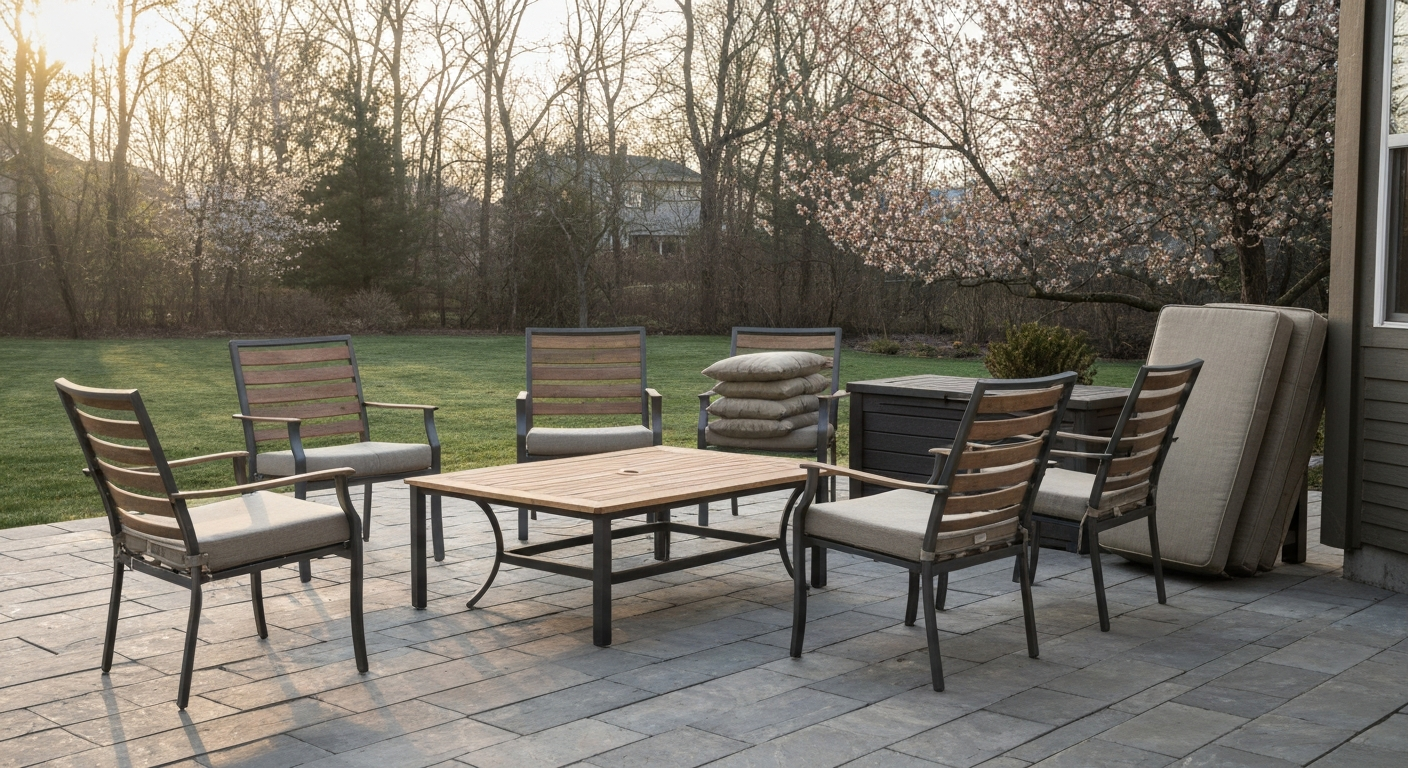
Timing rules and temperature thresholds to follow
The National Weather Service issues a Frost Advisory when surface temperatures are expected to dip into the mid-30s°F with clear skies and light winds, and a Freeze Warning when temperatures are forecast to reach 32°F (0°C) or below. Both of those are objective signals that it is too early for cushions, fabric pieces, or any furniture with finishes that can be damaged by ice formation. For structural frames made from durable materials, the bar is lower, but there is still no good reason to drag everything out before the weather cooperates.
NOAA publishes average last spring freeze dates using 1991-2020 climate normals, and most cooperative extension offices offer ZIP-level lookup tools built on NOAA/PRISM data. These are your starting point, not a guarantee. Median freeze dates mean roughly half of years see a later freeze than that date, so building in a one- to two-week buffer after the median is smart.
Seasonal deployment checklist
- Look up your location's average last spring freeze date using your state's NWS office, a cooperative extension tool, or NOAA's frost/freeze climatology maps.
- Add a one- to two-week buffer past that median date before deploying cushions or fabric-based pieces.
- Check the 10-day forecast for any Frost Advisory or Freeze Warning before moving anything out.
- Put out frames and hard surfaces first — aluminum chairs, teak tables, steel frames — once nighttime temps stay consistently in the upper 30s or above.
- Add cushions, fabric covers, and wicker or resin wicker pieces only after the last advisory clears your area.
- For fall storage, reverse the logic: when your first fall freeze date approaches and the 10-day forecast shows a Freeze Warning, pull cushions in immediately and evaluate frames based on material (more on that below).
How your local climate shifts the timing
National frost date maps are averages, and your specific backyard conditions can shift them by several weeks in either direction. NOAA notes that urban areas and locations near large bodies of water tend to see earlier last spring freezes and later first fall freezes because water and urban heat islands buffer temperature swings. Low-lying spots, valley bottoms, and north-facing slopes collect cold air and are higher-risk than surrounding areas at the same elevation. Knowing which of these categories describes your yard matters more than the ZIP code average.
| Climate Zone | Typical Deployment Window | Key Risks | Practical Adjustment |
|---|---|---|---|
| Cold/snowy (Zones 3–5, Upper Midwest, Mountain West) | Late April to mid-May for frames; late May for cushions | Freeze-thaw cycles, road salt spray, late-season snow loads | Wait for a stable 10-day forecast with no freeze warnings; use furniture covers or storage for cushions until Memorial Day |
| Temperate (Zones 6–7, Mid-Atlantic, Pacific Northwest, Central Plains) | Mid-March to early April for frames; late March or April for cushions | Surprise late freezes, high spring rainfall, mold on stored cushions | Check median last frost for your county; buffer two weeks; watch for late cold snaps |
| Hot/humid (Zones 8–9, Southeast, Gulf Coast, Florida) | February or earlier for frames; March for cushions in northern sub-zones; year-round in South Florida | UV degradation, mold and mildew on fabrics, hurricane season anchoring concerns | Prioritize UV-resistant and mold-resistant materials; plan for hurricane season from June 1 onward |
| Coastal/salt air (any zone within a few miles of ocean) | Timing similar to zone above, but corrosion risk is ongoing | Accelerated metal corrosion, salt deposit buildup on finishes, UV amplified by reflective water | Choose marine-grade finishes; rinse furniture weekly during high-use season; check coatings every spring |
| Desert/arid (Zones 8–11, Southwest, Arizona, Nevada) | Late February or March for most; year-round possible in low desert | Intense UV fading, thermal cycling cracking finishes, rare but serious freeze events at elevation | Focus on UV-rated materials; never assume a freeze is impossible if you are above 2,000 ft elevation |
Check the short-term forecast before you carry anything outside
Even when the calendar says it should be fine, a quick look at the 10-day forecast can save you a lot of hassle. There are four specific conditions worth checking before you deploy furniture for the season.
Cold snaps and freeze events
A single overnight dip to 28°F after a week of 60°F days is enough to crack some wicker weaves, freeze moisture into wood joints, and damage fabric fibers. NWS Frost Advisories (mid-30s) and Freeze Warnings (32°F and below) are the two alerts to track. If either appears in the 10-day outlook for your area, hold off on cushions and wicker pieces. Hard frames from aluminum or solid teak are more forgiving, but anything with a water-based sealant or fresh paint should stay inside until the threat passes.
Rain and standing water
Early spring often brings heavy rain events before furniture is fully set up or anchored. Cushions left out in sustained rain, then packed away, become mildew incubators. If there is a multi-day rain event in the forecast, wait. It is also worth checking whether your patio drains well, standing water around furniture legs accelerates corrosion on steel and degrades wood finishes from the bottom up.
Pollen season
This one catches a lot of people off guard. The National Allergy Bureau (operated by the American Academy of Allergy, Asthma and Immunology) tracks regional pollen counts and seasons, tree pollen peaks in spring, grass pollen in late spring through early summer, and ragweed takes over in late summer and fall. Heavy pollen deposits on cushions and fabric surfaces are not just an allergy issue: fine pollen particles create a grit layer that accelerates fabric wear, and organic material trapped in weaves feeds mildew. If you are in a high-pollen region and you put cushions out during peak tree pollen season, plan to rinse them monthly and do a proper cleaning before you store them. Sunbrella and similar solution-dyed acrylic fabrics handle this better than cheaper alternatives, but no fabric is immune.
Wind and UV exposure
Strong early-season wind events can send lightweight chairs across a yard and into a fence, a window, or a neighbor's property. Before setting out lighter pieces, make sure you have anchor options, furniture feet pads, patio weights, or tie-down systems. UV exposure is also worth a thought: early deployment in a high-UV climate means more cumulative fade on cushion fabrics and finish degradation on wood surfaces over the season. If your furniture will be in full sun in a desert or coastal environment, starting the season with clean, sealed, or re-oiled surfaces gives you better protection across the full season.
Can you actually leave patio furniture outside?
Whether furniture can safely stay outside depends on the material, your climate, and how well the pieces are protected. For a dedicated, detailed discussion on whether patio furniture can be left outside year-round, see Can patio furniture be left outside Can patio furniture be left outside?. If you’re thinking about keeping pieces inside instead of leaving them outdoors, see our guide on using patio furniture indoors for tips on suitability and care. The honest answer is that some materials handle year-round outdoor exposure reasonably well; others deteriorate fast without seasonal storage. This topic is worth its own deep-dive, but the short version for timing purposes: if you are deciding whether to put furniture out early, factor in whether you are also willing to leave it out through any remaining cold or wet weather, or whether you will actually bring it back in if the forecast turns bad. See our guide on when to bring in patio furniture for specific, actionable timing and care advice. If you're wondering whether you should bring in patio furniture in winter, read our detailed guide on that question should you bring in patio furniture in winter. If you're wondering "can I use patio furniture in my living room", see guidance on adapting outdoor pieces for indoor use. If the answer is you probably will not bring it back in, that should push your deployment date later.
| Material | Risk if Left Outside Early-Season | Minimum Protection Recommended |
|---|---|---|
| Cast aluminum (powder-coated) | Low — handles freeze-thaw well; finish can chip if impacted while brittle | Cover or store cushions; inspect coating annually |
| Teak / tropical hardwood | Low to moderate — wood is durable but joints can absorb moisture in repeated wet/freeze cycles | Re-oil before first season; cover during hard freezes if possible |
| Cedar / treated lumber | Moderate — less dense than teak; freeze-thaw can accelerate checking; finish erodes faster | Seal or paint annually; store or cover during extended wet cold |
| Steel / wrought iron | Moderate to high — any coating breach in early wet season becomes a rust start point fast | Inspect and touch up chips before deploying; cover during rain; never leave standing water |
| All-weather wicker / resin wicker | Moderate — quality HDPE wicker handles cold better than natural wicker but cold brittleness is real | Avoid deploying in hard freeze conditions; cover or store if freezing temps expected |
| Fabric cushions | High — moisture, frost, and pollen damage fabric and fill; mildew starts fast | Never deploy if Frost Advisory or Freeze Warning is active; bring in during sustained rain |
| Natural wicker / rattan | Very high — frost destroys natural fiber wicker quickly | Indoor or fully covered storage mandatory during any frost risk |
How to use these material checklists
The sections below break down timing and care by material category. If you have a mixed set, aluminum frames with teak accents and Sunbrella cushions, for example, apply the most conservative timing rule in the set, which is usually the cushions. The frames can go out earlier; the cushions define when you are truly deployed for the season. These checklists are meant to be run once at the start of each season, not just when something looks wrong. Catching a coating chip, a rust spot, or a swelling joint in April is a 20-minute fix; finding the same problem in August after six weeks of rain is a weekend project.
Wood patio furniture: teak, cedar, and treated lumber
Wood is the most variable category in outdoor furniture because species matters enormously. Teak is in a different class from cedar, and cedar is a different class from untreated pine. The USDA Forest Products Laboratory's Wood Handbook is the engineering reference here, and it is blunt: non-durable species left outdoors without treatment will rot, swell, and check rapidly. For authoritative, engineering-level detail on species durability and outdoor performance, see the Wood Handbook, Wood as an Engineering Material (USDA Forest Products Laboratory) Wood Handbook — Wood as an Engineering Material (USDA Forest Products Laboratory). Teak, on the other hand, has high natural oil content and is rated Class 1 durability by most wood classification systems, it can last decades with minimal structural decay even with outdoor exposure, though the surface will silver to a gray patina without maintenance. That silvering is purely cosmetic but worth knowing about if you care about the original warm honey color.
Cedar sits in the middle, naturally rot-resistant compared to most softwoods, but not in the same league as teak for long-term exposure. Pressure-treated lumber extends service life for structural pieces but is not typically used in quality furniture because the treatment chemicals and uneven coloring make for a rough aesthetic. For outdoor furniture specifically, if you are choosing wood, teak and acacia are the materials that actually justify the investment for durability; cedar is acceptable if you are willing to refinish it regularly.
Wood furniture: spring deployment checklist
- Inspect all joints and end grain for swelling, checking (splitting), or soft spots that indicate moisture damage over winter.
- Sand any rough or gray surface lightly (220-grit) if you want to restore color before applying a fresh finish.
- Apply teak oil, Danish oil, or a penetrating wood sealer appropriate for your species before the first wet season; do not skip this if the furniture sat uncovered all winter.
- Check all metal hardware — bolts, screws, bracket fittings — for rust or corrosion; replace any stainless steel fasteners showing rust with marine-grade 316 stainless.
- Do not deploy wood furniture onto a surface where standing water will pool around the legs; use furniture feet or consider teak plugs to protect leg bottoms.
- If nighttime temps are still dropping into the low 30s, keep wood furniture covered or indoors; repeated freeze-thaw with moisture in the wood accelerates joint failure.
- For cedar or treated lumber, apply a fresh coat of exterior sealant or paint every one to two years; check the finish integrity before the rainy season begins.
What to realistically expect from wood over time
A quality teak set purchased from a reputable manufacturer and given basic annual maintenance, cleaning, light sanding, a coat of oil every year or two, can last 20 to 30 years outdoors. Cedar sets will last 8 to 15 years with regular refinishing. Cheaper hardwood sets marketed as 'acacia' or 'eucalyptus' vary wildly by quality; look for pieces with thick slats (at least 1 inch), mortise-and-tenon or stainless-bolted joinery, and a stated country of origin with FSC or similar certification. Thin slat construction with stapled or doweled joints on any wood species will fail within a few seasons regardless of species.
Metal furniture: aluminum, steel, and wrought iron
Metal furniture breaks cleanly into two categories from a durability standpoint: aluminum and everything else. Cast or extruded aluminum with a quality powder-coat finish is the most maintenance-friendly outdoor furniture material available. It does not rust, handles heat and cold well, and a good powder-coat can last a decade or more without significant degradation. Steel and wrought iron are heavier, classically beautiful, and genuinely durable, but they rust. Once rust starts, it accelerates, and the maintenance burden is real.
Coastal environments are where the distinction becomes critical. The American Galvanizers Association classifies outdoor atmospheric corrosion environments from C1 (dry indoor) to C5 and CX (marine and highly industrial), and the corrosion rates in C5/CX are dramatically higher than inland conditions. If you are within a few miles of the ocean, steel and wrought iron require serious annual maintenance to stay ahead of rust, and even then you are fighting the environment. Powder-coated or anodized aluminum and 316 stainless hardware are the recommended specification for coastal installations. ASTM B117 salt spray testing is sometimes cited by manufacturers as a durability metric, but be aware it is an accelerated lab test, a coating that passes 500 hours of B117 does not directly translate to any specific number of years in your backyard.
What to look for in a quality metal frame
- Powder-coat thickness matters: look for manufacturers who specify at least 2–3 mil dry film thickness; thicker coatings resist chipping and UV degradation longer.
- Weld quality is visible at the joints: clean, consistent welds without gaps or porosity indicate better structural integrity and fewer rust entry points on steel.
- Hardware grade: all fasteners should be 304 or (for coastal use) 316 stainless steel; zinc-plated or cadmium hardware will rust in one or two seasons.
- Warranty terms are a meaningful quality signal: brands offering 5+ year structural warranties and explicitly covering powder-coat delamination are backing up their manufacturing claims.
- Hollow vs. cast aluminum: cast aluminum is heavier and more rigid but not inherently better; extruded aluminum frames can be excellent if wall thickness is adequate (look for at least 1.5mm).
- Steel sets should be hot-dip galvanized or heavily powder-coated; look for any exposed cut edges, drilled holes, or welds that have not been treated — those are rust start points.
Metal furniture: spring inspection and deployment checklist
- Inspect the entire frame under good light for coating chips, scratches, or bubbling — bubbling under the powder coat means rust has already started beneath the surface.
- Touch up any chips on steel immediately with a rust-inhibiting primer and matching touch-up paint before the piece goes outside; do not wait.
- For aluminum, chips are cosmetic rather than structural, but still worth touching up to prevent oxidation pitting under the finish.
- Clean all frames with mild dish soap and water to remove winter grime, salt deposits (if stored in a garage near road salt), and any biological growth.
- Check all hardware — bolts, screws, sling frame rivets, hinges — for corrosion or loosening; re-tighten or replace as needed.
- If you are near the coast, rinse aluminum frames with fresh water before storage and again before deployment; salt crystal deposits are abrasive to finishes.
- Confirm that any adjustable or reclining mechanisms move freely; lubricate with a silicone-based spray (not WD-40, which attracts dust) if they are stiff.
- Do not deploy steel or wrought iron furniture during early-season sustained rain without rust touch-ups completed; wet conditions accelerate any exposed metal's degradation exponentially.
Aluminum vs. steel: which one should you choose?
If low maintenance and long-term durability are your priorities, cast or extruded aluminum wins outright. It handles every climate, does not rust, and a quality powder-coat finish will outlast most steel sets with a fraction of the maintenance. Steel and wrought iron have a visual weight and presence that aluminum genuinely cannot replicate, thick wrought iron scroll work or a heavy steel frame looks substantial in a way that hollow aluminum does not. If you love the look and are willing to do annual touch-up work, steel is worth it. If you are in a coastal environment or a high-humidity climate and want something you can mostly ignore except for an annual wash-down, go aluminum.
The bottom line on timing
The real answer to whether it is too early to put out patio furniture comes down to three things: your local last frost date, what the 10-day forecast shows, and what materials your furniture is made from. For a quick localized answer to when should you put out patio furniture, consult your county extension office or NOAA's last spring freeze date lookup for your ZIP code. Hard frames in aluminum or quality teak can typically go out a few weeks before you deploy cushions without much risk. Cushions, wicker, and fabric pieces should wait until the NWS stops issuing Frost Advisories and Freeze Warnings for your area. That might be late February in South Florida and late May in the Upper Midwest, and the USDA zone map and your county extension office will give you a much better answer than any general calendar rule. Once the furniture is out, plan for seasonal maintenance to match the material: wood needs inspection and re-oiling, metal needs a coating check, and cushions need periodic rinsing during pollen season. The furniture that lasts is the furniture that gets looked after. If you're wondering whether outdoor pieces need to match, see does outdoor patio furniture have to match for practical tips on mixing styles, coordinating colors, and creating a cohesive look.
FAQ
How do I know whether it’s too early to put out patio furniture in spring?
Use your local last‑spring‑freeze date as the baseline, then adjust for microclimate and short‑term forecasts. If your area’s median last frost is past and no Freeze Warnings or Frost Advisories (temperatures ≤32°F or mid‑30s°F at night) are expected in the next 7–10 days, it’s generally safe to deploy hard furniture. Delay placing unprotected cushions, fabric or newly finished wood until night temperatures stay above freezing and no heavy rain/pollen events are forecast.
What short‑term weather alerts should stop me from putting furniture out?
Do not deploy cushions or unprotected fabrics if a Freeze Warning (≤32°F) or Frost Advisory (mid‑30s°F with frost risk) is forecast. Postpone if heavy rain, hail, or high wind warnings are in effect, and consider pollen forecasts—high pollen days will quickly coat cushions and fabrics and may require extra cleaning.
How should I adjust timing based on my local climate and microclimate?
Start with your county’s last frost/first freeze maps and USDA hardiness zone, then adjust for microclimate: coastal and urban areas often have longer frost‑free seasons (safer earlier); valley bottoms, shaded north slopes, or high elevations freeze later (be more conservative). If your yard has cold pockets, keep sensitive items stored until those areas consistently stay warm.
When is it safe to leave patio furniture outside permanently?
Hard, weather‑rated furniture (powder‑coated aluminum, marine‑grade stainless, teak, high‑density composite) can be left outside year‑round in many climates—except in severe coastal salt spray zones or where corrosive winters occur. For wood, lower‑grade metals, or cheap wicker, plan seasonal storage or heavy protection. Always follow the manufacturer’s coastal/winter guidance and warranty limitations.
Material‑by‑material checklist: what should I know about wood, metal, wicker, and composite?
Wood: Teak/cedar/rated hardwoods—durable but will silver and may need oil/finish; untreated softwoods will rot without treatment. Metal: Powder‑coated or anodized aluminum resists rust; 316 stainless is best near coasts; painted steel or low‑grade metals corrode faster—check galvanizing and warranty. Wicker/rattan: Synthetic/resin wicker is outdoor‑rated; natural wicker is unsuitable for prolonged wet exposure. Composite/HDPE: Very durable, low maintenance; check UV ratings and colorfastness. For each, confirm hardware (stainless or hot‑dip galvanized) and manufacturer coastal ratings.
How should I handle cushions and outdoor fabrics when deciding when to put them out?
Only place cushions outside when nights are reliably above freezing and no heavy rain is forecast. Use solution‑dyed acrylics (e.g., Sunbrella) or outdoor performance fabrics for resistance to UV, pollen staining and mildew. Store cushions indoors or in a ventilated storage box during prolonged wet/cold spells. During high‑pollen season, cover or store cushions nightly and rinse monthly; deep clean per manufacturer every 1–3 years.
Next Articles
Should You Bring in Patio Furniture in Winter? (Guide)
Rules for bringing patio furniture in winter by material, with step-by-step storage and cover plans to prevent damage.
Can I Use Patio Furniture in My Living Room? Pros and Tips
Yes, with the right materials and protection. Get indoor setup, floor care, maintenance tips for patio furniture.
Can You Mix and Match Patio Furniture Here’s How
Step-by-step rules to mix and match patio furniture, match styles and comfort, and choose weatherproof materials that la