
Yes, homeowners insurance typically covers patio furniture, but only for specific covered perils (fire, theft, windstorm, hail, vandalism) and only up to your Coverage C personal property limit minus your deductible. If your policy settles at actual cash value rather than replacement cost, depreciation can significantly cut your payout. Flood damage, normal wear and tear, and gradual weathering are almost never covered, and certain high-cost outdoor sets may bump against sublimits that leave a meaningful gap between what you paid and what your insurer will write a check for.
Does homeowners insurance cover patio furniture? Key Facts

Theo Tierney
20 Jul 2026
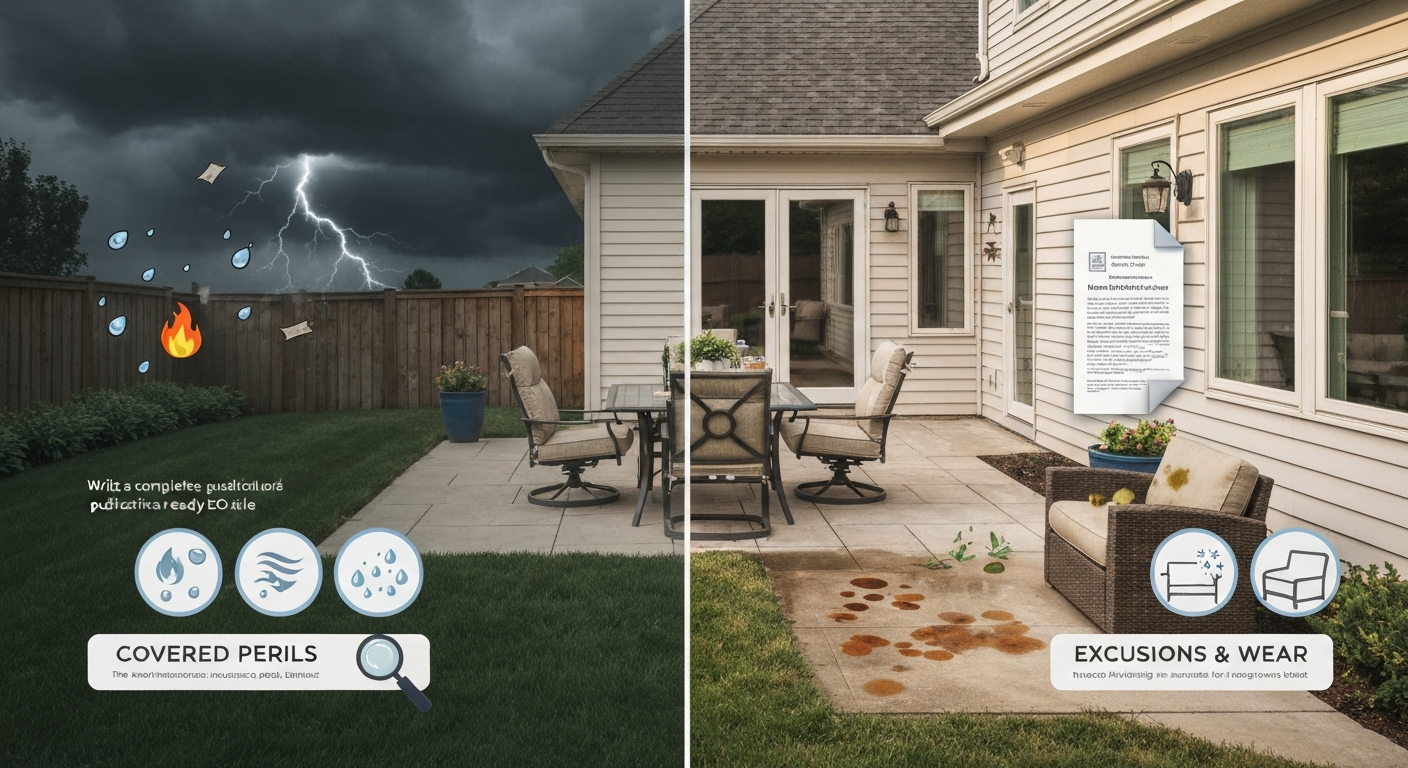
How standard homeowners policies treat patio furniture
Patio furniture is personal property under homeowners insurance, which means it falls under Coverage C on a standard ISO HO-3 policy. Coverage C is designed to protect the contents of your home, but the language extends to personal property anywhere in the world, not just items sitting in your living room. That global reach sounds reassuring, but the key limitation is that coverage only applies to named perils on an HO-3. You need the loss to fit a specific cause listed in the policy, such as fire, windstorm, hail, theft, or vandalism.
An HO-5 policy is broader because it covers personal property on an open-perils basis, meaning any cause of loss is covered unless specifically excluded. If your insurer wrote you an HO-5, your outdoor furniture has meaningfully better protection than under an HO-3. That said, the core exclusions (flood, wear and tear, intentional damage, gradual deterioration) survive in both forms. Most homeowners I talk to are on HO-3 policies, so the named-peril framework is what usually matters in practice.
One thing worth knowing: insurers treat patio furniture the same as indoor furniture under Coverage C. There is no blanket carve-out that says 'outdoor property is excluded.' The furniture on your deck, the cushions piled in the corner, the side tables you bought last spring: all personal property, all eligible for Coverage C claims when a covered peril causes the loss.
Perils that typically cover patio furniture
Under an HO-3, the covered perils for personal property are listed explicitly. Most standard policies include the following as covered causes of loss for outdoor furniture:
- Fire and lightning: A fire that spreads from a neighbor's property or a grill mishap that burns your furniture set is a clean covered loss in virtually every policy.
- Windstorm and hail: Wind scattering chairs across the yard or hail denting a metal table qualifies, but some coastal or high-wind-zone policies apply a separate wind/hurricane deductible (more on that below).
- Theft: A stolen patio set, stolen cushions, or even a stolen gas grill is usually covered under the theft peril, subject to your deductible and off-premises sublimits if the item was stolen somewhere other than your home.
- Vandalism and malicious mischief: If someone deliberately damages your outdoor furniture, that's covered under most HO-3 policies.
- Riot or civil commotion: Less common, but it's a named peril in the standard form.
- Falling objects: A tree branch or a piece of roofing that lands on your teak dining table would typically qualify under this peril.
- Weight of ice, snow, or sleet: In northern climates, this one matters. If accumulated ice crushes a patio chair or storage unit, that damage falls under a covered peril.
USAA, State Farm, and Allstate consumer guidance all confirm that outdoor furniture qualifies for personal property coverage under perils like fire, hail, and theft. The friction points come from exclusions, deductibles, and how the payout is calculated, not from a blanket rejection of outdoor furniture as a covered item.
Replacement cost vs. actual cash value: what you actually get paid
This is where homeowners get surprised. Whether your policy pays replacement cost value (RCV) or actual cash value (ACV) for personal property makes a dramatic difference, especially on furniture that has been outside for a few seasons.
ACV is replacement cost minus depreciation. A $2,000 aluminum sectional that is three years old might depreciate 40-50% in an adjuster's depreciation schedule, meaning your check is closer to $1,000 before the deductible comes out. RCV pays what it costs to buy an equivalent new item today, which is a far better outcome. Most standard HO-3 policies default to ACV for personal property unless you've added a replacement cost endorsement or are on an HO-5.
Even on HO-5 and RCV endorsement policies, carriers commonly pay ACV first and release the additional amount (the recoverable depreciation) only after you actually replace the item and submit proof of purchase. Most carriers pay ACV first and release the recoverable depreciation only after replacement and proof of purchase; see HOMEOWNERS HO 00 05 (sample), Replacement cost / ACV conversion language (Openly PDF) for typical 180‑day notice requirements blank" rel="noopener noreferrer">HOMEOWNERS HO 00 05 (sample) — Replacement cost / ACV conversion language (Openly PDF). Some standard forms require you to notify the insurer of your intent to replace within 180 days of the loss to preserve your right to the full RCV payout. If you never replace the furniture, you keep only the ACV. This is standard industry practice and something most homeowners don't realize until they're already in the middle of a claim.
| Settlement Type | How It Works | Typical Outcome on a $2,000 Set (3 Years Old) | What You Need to Do |
|---|---|---|---|
| Actual Cash Value (ACV) | Replacement cost minus depreciation | ~$900-$1,200 before deductible | Nothing additional; this is the base payout |
| Replacement Cost Value (RCV) | Full cost to replace with equivalent new item | ~$2,000 before deductible | Replace the item and submit receipts within carrier's stated window (often 180 days) |
| Scheduled Personal Property | Agreed or appraised value for specific listed items | Agreed value (e.g., $3,500 for a high-end set) | Requires prior scheduling and premium add-on |
If you have a high-value outdoor furniture set (think premium teak, cast iron, or a high-end composite collection running $3,000 or more), scheduling it as a separate endorsement is worth pricing out. Standard Coverage C limits and depreciation schedules weren't built with premium outdoor furniture in mind.
Common exclusions, sublimits, and deductible problems to know
Flood damage
This one catches homeowners badly. Standard homeowners policies, both HO-3 and HO-5, exclude flood. If a storm surge, heavy rain, or rising water level sweeps through your patio and ruins your furniture, your homeowners carrier will likely deny the claim. NFIP flood insurance policies do cover contents (personal property), but there's a critical catch: the NFIP's Standard Flood Insurance Policy excludes personal property located outside the insured building. Patio furniture sitting on the deck during a flood event is outside the building, which means NFIP won't cover it either. That's a gap most people don't anticipate.
Wear and tear, gradual damage, and weathering
Every homeowners policy excludes wear and tear, gradual deterioration, and damage caused by lack of maintenance. Rust that develops on iron furniture over several seasons, UV fading on wicker, rot in untreated wood, or cushion degradation from prolonged moisture exposure: none of that is a claim. These are maintenance issues, not insurable events. From a material standpoint, this is exactly why material choice matters so much in climates with heavy rain, humidity, or salt air. Insurance won't bail you out of poor material decisions.
Deductibles and hurricane/wind deductibles
Your standard deductible applies to personal property claims. If you have a $1,500 deductible and your patio furniture sustained $2,000 in wind damage, you're getting a check for $500 at ACV before depreciation is applied, which may result in a net payment that barely covers anything. In Florida and other coastal states, a separate hurricane or named-storm deductible applies to wind losses, and these are commonly set as a percentage of your dwelling's insured value: 2%, 5%, or even 10%. On a $400,000 home, a 2% hurricane deductible is $8,000. Almost no patio furniture claim survives that math. Florida law requires insurers to offer these percentage deductibles as options, but they're widely applied in coastal policies, often without homeowners fully internalizing the impact on small claims.
High-value items and Coverage C sublimits
Coverage C typically has a stated overall limit (often 50-70% of your dwelling coverage), but within that limit, some categories of property face sublimits. Patio furniture doesn't usually carry its own sublimit the way jewelry or electronics do, but if your total outdoor furniture inventory (furniture, cushions, covers, accessories, grills) pushes against your overall Coverage C limit, you may have a shortfall. Check what your Coverage C limit actually is and compare it to the total replacement value of your outdoor and indoor personal property combined.
Off-premises, in-transit, and storage coverage
The worldwide personal property coverage in your HO-3 or HO-5 sounds broad, but off-premises personal property is commonly subject to a sublimit. A typical example: if your Coverage C limit is $100,000, your policy may cap off-premises losses at 10%, or $10,000. The NFIP's Standard Flood Insurance Policy text and recent rulemaking (see National Flood Insurance Program: Standard Flood Insurance Policy (SFIP) changes, Federal Register (Justia summary)) impose a 10% limit on personal property located at a location other than the described insured location, with specific exceptions for temporary moves for safety or evacuation National Flood Insurance Program: Standard Flood Insurance Policy (SFIP) changes — Federal Register (Justia summary). Allstate consumer guidance specifically illustrates this scenario. For most patio furniture claims, the furniture is at your home, so the standard limit applies. But if your furniture was stolen from a vacation rental, a storage facility, or was in transit during a move, the off-premises sublimit kicks in.
Storage facilities present a particularly common scenario when homeowners winterize their outdoor spaces and move furniture into a commercial storage unit. That furniture is off-premises, and the 10% sublimit would apply to any covered loss there. If you're storing $6,000 worth of outdoor furniture and your off-premises cap is $10,000, you're fine. But if you're storing $15,000 worth across a large collection, it's worth calling your agent to either raise the off-premises limit or explore whether the storage facility's own insurance fills the gap.
How weather, materials, cushions, and covers affect damage risk and claim outcomes
Material choice doesn't change your policy terms, but it absolutely changes your exposure to losses that are either covered or excluded. This is a distinction worth understanding before you buy. For practical tips on protecting patio furniture when it rains, consult our guide on patio furniture when it rains.
Wind damage to furniture is a covered peril under most policies, but insurers can reduce or deny a wind claim if you failed to take reasonable protective steps when a storm was forecast. State Farm's preparedness materials explicitly advise securing or moving patio furniture before wind events, and claim adjusters do scrutinize whether an insured made reasonable mitigation efforts. If you left unsecured lightweight aluminum chairs out during a hurricane watch, that could factor into a disputed claim. Anchoring furniture, using quality weatherproof covers, and storing cushions ahead of storms isn't just good maintenance practice: it protects your claim eligibility.
Heavier materials (cast aluminum, thick teak, dense concrete-composite tops) are less likely to become projectiles in wind events and less likely to sustain damage that triggers a claim. Lightweight resin, thin tubular steel, and budget wicker are more vulnerable. From a pure insurance math standpoint, materials that resist wind damage, moisture infiltration, and UV degradation give you fewer occasions to file a claim and keep wear-and-tear exclusions from eating your coverage.
Cushions deserve specific attention here. Standard polyester-fill cushions that absorb water and remain damp are prone to mildew, which is a gradual damage exclusion, not a covered loss. See our guide Are patio furniture cushions waterproof? for details on cushion materials and moisture resistance. For guidance on choosing patio furniture that can get wet, see our detailed recommendations. Solution-dyed acrylic cushions (Sunbrella being the most widely recognized) resist moisture far better and are less likely to develop the slow-burn mildew damage that no policy will touch. Similarly, furniture covers designed for genuine weather resistance reduce the incidence of hail dings, debris scratches, and UV cracking that insurers would classify as maintenance failures. If you’re wondering whether patio furniture covers are actually waterproof, see our guide titled “are patio furniture covers waterproof” for testing results and buying tips. Protecting your gear isn't just thrift: it's claim hygiene.
'Waterproof' branding and brand names don't affect your policy
This comes up more than you'd think. If you're wondering whether patio furniture can get wet and how that affects coverage, see our guide can patio furniture get wet for practical advice. Homeowners sometimes assume that furniture marketed as weatherproof, all-weather, or waterproof, whether it's a Hampton Bay set from The Home Depot or a premium brand with a 10-year warranty, somehow translates into better insurance coverage or a smoother claim experience. For buyers, see our guide to the best waterproof patio furniture to help choose materials that resist weathering and reduce claim risk. It doesn't. Your insurance contract doesn't reference the manufacturer's marketing language, the retailer's warranty, or the material's rated weather resistance. Is Hampton Bay patio furniture waterproof? Read our detailed guide on Hampton Bay's weather resistance and what that means for insurance claims. If you're asking whether patio furniture is waterproof, remember that the term is marketing language and does not change insurance coverage or prevent gradual weathering is patio furniture waterproof. What the adjuster looks at is whether a covered peril caused the loss, what the item is worth (per the depreciation schedule), and whether the damage is consistent with the claimed cause.
A Hampton Bay sectional, a Restoration Hardware teak table, or a budget resin set from a big-box store all fall into the same Coverage C bucket. The adjuster applies the same ACV depreciation schedule to each. The brand name, the price point, and the weatherproof marketing copy are entirely irrelevant to the claim settlement process. What does matter is what you paid, what the item would cost to replace new today, and how old it is. Keep receipts, and if you bought something expensive, photograph it while it's new so you have proof of condition and value.
Filing a claim: what to do and when it actually makes sense
Documentation steps after damage or theft
- Photograph and video the damage immediately, before moving or disposing of anything. Capture the full scene and close-ups of individual items.
- Keep damaged furniture and components on-site until an adjuster has inspected or explicitly authorized disposal. New York DFS consumer guidance specifically advises keeping damaged property until settlement.
- Gather purchase receipts, credit card statements, or any proof of what you paid. If you don't have receipts, screenshots of current comparable products on retailer sites help establish replacement value.
- For theft, file a police report immediately. Most carriers require a police report number to process a theft claim.
- Make reasonable temporary repairs to prevent additional damage (covering exposed areas with tarps, for example) and keep all receipts for those emergency expenses. California DOI guidance and State Farm claims materials both advise this step.
- Contact your insurer to open the claim and ask directly: Does my policy pay ACV or RCV for personal property? What is my deductible? Is a hurricane/wind deductible applicable here?
- Follow up in writing (email) to create a paper trail, and keep notes on every call including the date, the representative's name, and what was discussed.
When it makes sense to file vs. self-insure
Filing a homeowners claim for patio furniture damage is genuinely worth it in some situations and genuinely not worth it in others. A claim can raise your premium at renewal, and small claims are sometimes better handled out of pocket to preserve your loss-free discount. Here's a practical framework:
| Scenario | File a Claim? | Why |
|---|---|---|
| Total loss of a large set worth $3,000+ and you have RCV coverage | Yes | RCV payout minus deductible likely covers most replacement cost |
| ACV policy, furniture is 5+ years old, loss is under $2,000 | Probably not | Depreciation plus deductible may leave you with little to nothing |
| Theft of multiple items with a combined value well above your deductible | Yes | Theft is clean to document and off-premises limits likely sufficient for on-premises theft |
| Hail or wind damage in a coastal state with a 2-5% wind deductible | Probably not unless damage is severe | Percentage deductible will likely exceed the furniture's depreciated value |
| Flood damage to outdoor furniture | No (homeowners) | Flood is excluded; NFIP also excludes outdoor property |
| Gradual rust, UV fade, mildew on cushions | No | This is wear and tear; carrier will deny the claim |
| Single chair damaged, value under your deductible | No | You'd pay the full loss yourself; filing a claim adds no value and creates a claims record |
How to adjust your coverage if your current policy isn't enough
If you've run through the above and concluded your policy leaves you exposed, there are practical levers to pull. The most impactful is upgrading from ACV to replacement cost settlement for personal property. This is typically available as an endorsement and costs modestly more in premium but changes your payout outcome dramatically, especially on relatively new furniture.
For high-value outdoor furniture (premium teak dining sets, designer composite collections, or anything over $3,000-$4,000 for a single configuration), scheduling the item under a scheduled personal property endorsement provides agreed-value or appraised-value coverage with no depreciation argument and sometimes no deductible. You'll need documentation of value, but for expensive outdoor furniture it's genuinely worth asking your agent about.
If theft risk is your primary concern and you store furniture off-premises seasonally, check whether your off-premises sublimit is adequate and ask about raising it. A standard 10% cap on $80,000 of Coverage C gives you $8,000 off-premises, which may cover most situations, but if you're moving a full outdoor living room worth $12,000 into a storage unit, you have a gap.
Flood coverage for outdoor personal property is essentially uninsurable through standard channels. The NFIP doesn't cover outdoor contents, and standard homeowners policies exclude flood entirely. Your best protection against flood losses to patio furniture is physical: move furniture indoors or to elevated locations when flooding is forecast, which is something you should be doing for material preservation reasons anyway.
Prevention and maintenance that actually protects your claim eligibility
Insurers don't just look at whether a covered peril occurred. They look at whether the insured took reasonable care of the property and made reasonable efforts to prevent further damage. That connects directly to material choices and maintenance habits that are worth building into your outdoor furniture routine regardless of insurance.
- Store or secure furniture before named storms, hurricane watches, and heavy wind events. Leaving lightweight furniture unsecured during a forecast event gives adjusters grounds to question the claim.
- Use furniture covers that actually fit and provide weather protection. Covers that trap moisture and cause rust or mildew create gradual damage that no policy covers, so quality matters here.
- Choose cushion fabrics rated for outdoor use, such as solution-dyed acrylic, rather than standard polyester. This reduces the risk of mildew-related damage that falls squarely in the wear-and-tear exclusion.
- Photograph your outdoor furniture setup seasonally. A timestamped photo library of your furniture in good condition establishes pre-loss value and condition if you ever need to support a claim.
- Keep purchase receipts in a home inventory document, either a spreadsheet or a dedicated home inventory app. This one step removes the biggest friction point in personal property claims.
- For metal furniture in coastal environments, apply appropriate protective coatings seasonally. Uncoated iron or low-grade aluminum in salt air conditions degrades quickly, and that degradation is never covered.
- Consider material weight and wind resistance when buying. Heavy cast aluminum, thick teak, and dense composite frames are less likely to become airborne in wind events than lightweight resin or thin steel.
The bottom line on patio furniture and homeowners insurance is this: coverage exists, the named perils that apply are meaningful (especially fire, theft, hail, and wind), but the practical payout on an ACV policy after depreciation and your deductible is often disappointing for anything short of a total loss event. Know your settlement type, understand your deductible situation (especially if you're in a wind/hurricane zone), document everything, and make material and maintenance choices that reduce both your physical losses and any insurer's ability to classify damage as a maintenance failure rather than a covered peril.
FAQ
Short answer: Does homeowners insurance cover patio furniture?
Usually yes for sudden, accidental losses from covered perils (fire, wind/hail, theft, vandalism) under the policy’s Personal Property (Coverage C), subject to your policy’s limits, deductibles, exclusions and any off‑premises sublimits. Coverage is limited or excluded for perils like flood, routine wear and tear, insect/rot, and sometimes for property kept permanently outdoors unless an endorsement applies.
Which perils typically cover patio furniture under a standard HO-3 or HO-5 policy?
HO‑3 covers listed named perils (fire, lightning, wind/hail, theft, vandalism, etc.) for personal property; HO‑5 often provides broader open‑perils coverage. Theft, fire, hail and many wind events are commonly covered. Flood and most ground‑water events are excluded unless you have flood insurance; deterioration, corrosion, and gradual damage are excluded.
How do limits and sublimits affect patio furniture coverage?
Coverage C is the total personal property limit. Insurers commonly apply an off‑premises or sublimit (e.g., a percentage of Coverage C or a stated cap) for items away from the residence. There are also special sublimits for certain property types (trees/shrubs, jewelry, etc.). Check your declarations page for specific caps; expensive sets may need scheduling to be fully protected.
Replacement cost vs. actual cash value (ACV): how will my insurer pay for damaged or stolen patio furniture?
If your policy includes replacement‑cost (RCV) for personal property, many insurers pay ACV (RCV minus depreciation) initially and remit the RCV remainder after you replace the item and provide receipts. ACV‑only policies pay depreciated value. Read your policy: some forms require a notice of intent to replace within a set time (commonly 180 days) to get full RCV.
Are there common exclusions and conditions that often deny patio furniture claims?
Yes. Typical exclusions: flood and sewer backup (without separate coverage), wear and tear/gradual deterioration, insect/rodent damage, rust/corrosion, improper maintenance, and sometimes theft if items were unsecured or left off‑premises beyond sublimits. Policy conditions like failure to mitigate (reasonable emergency measures) or not providing proof of ownership can also reduce or deny payment.
How do weather, materials, cushions and covers affect coverage and claim outcomes?
Insurers expect reasonable maintenance and mitigation. If damage results from a covered peril (e.g., sudden hail) it’s generally covered; if cushions rot from prolonged exposure or covers failed to be used, an insurer may deny for neglect. Durable, weather‑rated materials and stored or securely covered cushions reduce damage risk and strengthen a claim. Failure to secure items during known severe‑weather warnings can hurt a claim.
Next Articles
Is Hampton Bay Patio Furniture Waterproof? Facts & Care
Is Hampton Bay patio furniture waterproof? Learn which materials resist rain, care tips, covers, and buying alternatives
Patio Furniture When It Rains: Waterproof vs Water-Resistant
Can patio furniture get wet? How to choose, protect & maintain models, cushions, covers, and warranties.
Are Patio Furniture Covers Waterproof? What to Know
Learn what waterproof means for patio covers, common failure points, and how to choose and install for dry outdoor furni