
If you or someone in your household is heavier, larger, or a senior who needs stable, supportive seating, the standard patio furniture aisle is quietly working against you. Most mass-market outdoor chairs are built to a 250 lb test load and priced to look good on a showroom floor, not to hold up under real daily use by a 275 lb person sitting down hard after a long day. The good news is that genuinely load-rated, well-built outdoor furniture exists across every material category, and once you know what specifications to look for, finding it becomes straightforward.
Best Patio Furniture for Heavy Person: Durable Seating Guide

Theo Tierney
14 Jul 2026
Why this matters more than most buyers realize
Outdoor furniture fails differently than indoor furniture. Frames are exposed to temperature swings, UV radiation, moisture, and freeze-thaw cycles that gradually degrade welds, fasteners, and finishes. A chair that technically passes a basic static load test at the factory may behave very differently after two Florida summers or three Minnesota winters. For heavier users, that degradation matters because any structural weakness gets amplified by higher sustained loads. A swivel base that wobbles slightly for a 180 lb person can collapse entirely for a 300 lb person. The U.S. Consumer Product Safety Commission has documented this pattern repeatedly, including a 2016 Brown Jordan swivel patio chair recall tied specifically to fall hazards from structural failure under load.
Seniors face a compounding challenge. Beyond raw weight capacity, older adults need specific seat geometry to safely perform sit-to-stand transfers without assistance. Research published in BMC Geriatrics on seating in aged care identifies seat height, seat depth, seat width, armrest height, and cushion firmness as the five variables most critical to safe independent transfers. See the peer‑reviewed article "Seating in aged care: Physical fit, independence and comfort (peer‑reviewed article, BMC Geriatrics)" for details linking seat height, depth, width, armrest height, and cushion firmness to safe independent transfers. A chair that is rated for 400 lbs but sits 14 inches off the ground is still a fall hazard for a 75-year-old with limited hip mobility. So for this audience, the buying decision involves both structural capacity and ergonomic geometry.
How weight ratings actually work
Weight ratings on patio furniture come from test standards, not from engineers simply doing math on a frame. The most rigorous and widely referenced standards in North America are ANSI/BIFMA X5.1 (the general seating test standard covering static load, stability, fatigue, and arm strength) and BIFMA X5.11, which is specifically designed for heavy-user or bariatric seating applications. BIFMA X5.11 provides dedicated test methods and guidance for heavy‑use (bariatric) seating BIFMA X5.11 provides dedicated test methods and guidance for heavy‑use (bariatric) seating.. Labs run these tests on production samples, applying static loads, repeated drop-impact cycles, and forward/lateral stability evaluations. If a chair passes the relevant X5.11 protocol, that rating has real engineering weight behind it.
In Europe, the equivalent framework is EN 581, a three-part standard covering general safety requirements (EN 581-1), mechanical safety and test methods for seating (EN 581-2), and tables (EN 581-3). EN 1728 and EN 16139 (covering non-domestic seating strength and durability) feed test methods into the EN 581 framework. For outdoor furniture sold in North American retail specifically, UL 4041 (the UL Outline of Investigation for Outdoor Furniture) adds corrosion resistance, stability, shear and pinch-point, and endurance tests on top of structural load requirements. Third-party certification labs like SGS, Intertek, and Bureau Veritas execute these protocols and issue test reports that manufacturers can cite.
The practical problem is that most residential patio furniture sold at home improvement stores and online retailers carries no certified rating at all. Manufacturers print a weight capacity number on the box because retail platforms require it, but that number may reflect an internal engineering estimate, a load applied once to a single prototype, or simply a number chosen to be competitive with similar products. When a product page says '300 lb capacity' but cites no testing standard, treat that figure as a starting estimate, not a safety guarantee.
Interpreting weight limits in practice
Even a legitimately tested weight rating does not mean that weight is a safe daily operating load. Standards-based test loads are typically applied once or a limited number of times to a new, undamaged sample. Real-world use involves hundreds or thousands of loading cycles over years, with an aging frame, degraded fasteners, and potentially loosened welds. A practical rule of thumb used by furniture specifiers and commercial buyers is to treat the rated capacity as a ceiling and target furniture whose rated capacity is at least 25 to 50 percent above your actual body weight. So if you weigh 280 lbs, look for chairs rated at 350 to 420 lbs, not 300 lbs.
Dynamic loading matters too. Sitting down quickly, shifting weight suddenly, or placing one arm heavily on a rest creates brief impact loads that can be 1.5 to 2 times your static body weight. This is why BIFMA X5.1 and X5.11 include drop-load and repeated-cycle tests, not just a static push-down. For folding chairs and swivel bases specifically, the failure points are almost always the pivot hardware, not the seat platform itself. If you are evaluating a swivel or reclining chair, inspect the pivot mechanism material and fastener quality as carefully as you would the frame.
How strict are those printed weight limits in practice? For a deeper look at how strict weight limits on patio chairs are in practice, see how strict are weight limits on patio chairs. Stricter than many buyers assume for well-engineered products, and far less strict than the number implies for budget products. There is an entire spectrum here, and the gap between a Polywood chair rated at 325 lbs with a 20-year structural warranty and a $79 folding chair with a '300 lb' label is enormous in real-world performance. The topic of how strictly manufacturers actually enforce and stand behind weight limits deserves its own careful look, particularly when considering what happens if a chair fails and you need to make a warranty claim.
Product spec criteria and recommended weight-capacity ranges
Here is what I use as minimum acceptable specifications when evaluating outdoor furniture for heavier users. These are concrete thresholds, not vague quality descriptors.
| Spec | Minimum for 200–275 lb user | Recommended for 275–400 lb user |
|---|---|---|
| Rated weight capacity | 350 lb | 400–500 lb |
| Seat width | 22 inches | 24–26 inches |
| Seat height (fixed) | 17–19 inches | 17–19 inches (ADA/ANSI transfer range) |
| Seat depth | 18–20 inches | 18–22 inches |
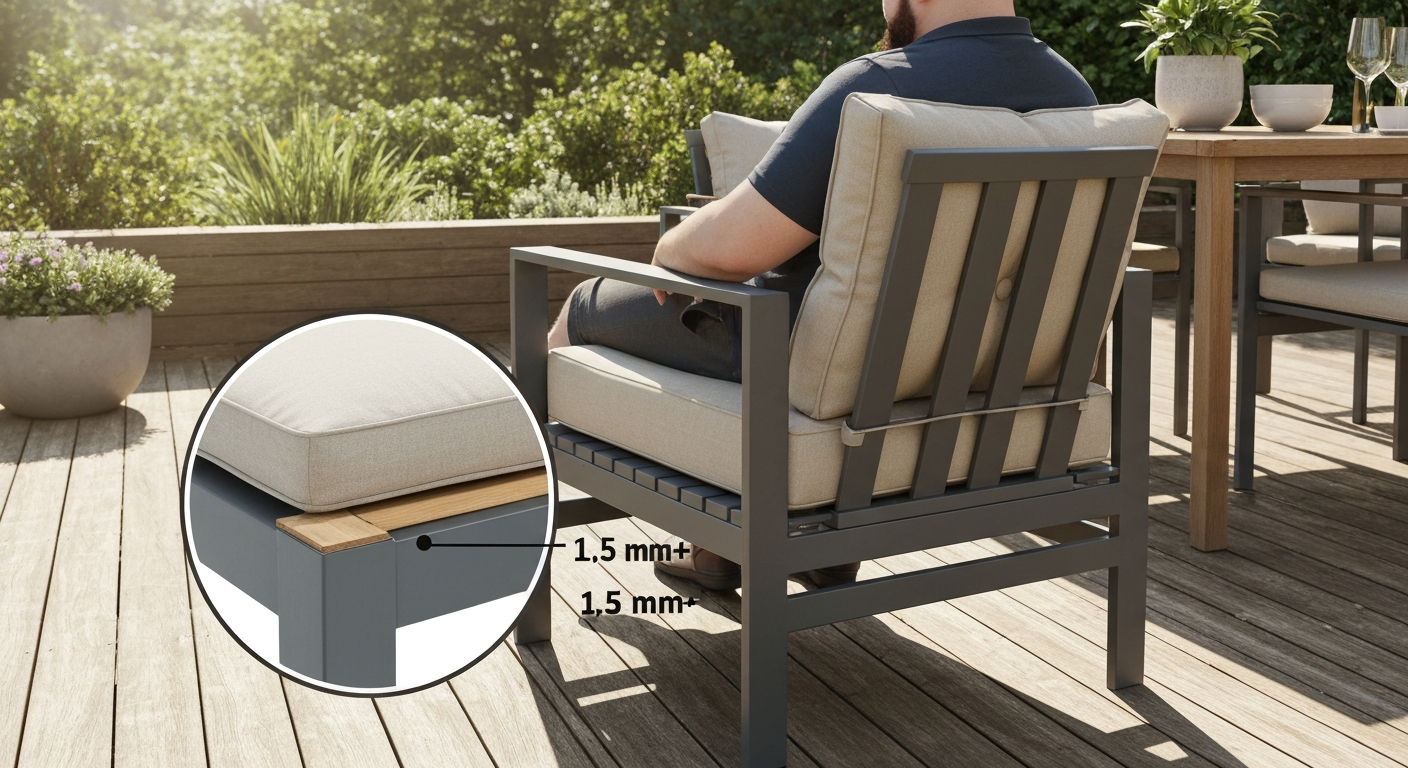
| Frame wall thickness (aluminum tube) | 1.2 mm minimum | 1.5–2.0 mm or solid stock |
| Foam density (cushion) | 1.8 lb/ft³ minimum | 2.0–2.5 lb/ft³ (bariatric: up to 5.0 lb/ft³) |
| Warranty coverage | 5 years structural | 10–20 years structural |
| Frame joinery | Welded or bolted | Welded preferred; avoid friction-fit only |
The seat height range of 17 to 19 inches is not arbitrary. ADA/ANSI accessibility standards target 17 to 19 inches (430 to 485 mm) above finished floor for transfer seating, and that same range aligns with ergonomic research on safe sit-to-stand transfers for older adults. For seniors especially, a chair sitting at 14 or 15 inches requires significantly more hip and knee force to exit, raising fall risk even when the structure itself is perfectly sound.
For cushion foam, density (weight per cubic foot) is the key indicator of bottoming-out resistance, not ILD (indentation load deflection) alone. Medical and bariatric seating manufacturers typically use foam cores in the 40 to 80 kg/m³ range (roughly 2.5 to 5.0 lb/ft³), assessed against ASTM D3574 test methods including compression set and fatigue cycling. Most residential outdoor cushions use foam in the 1.5 to 1.8 lb/ft³ range, which is adequate for lighter users but will compress permanently and bottom out within one or two seasons under sustained heavier loads. If you are buying furniture separately from cushions, upgrading the cushion foam is often the highest-value modification you can make.
The buying checklist
Before committing to any purchase, run through these questions. They are organized from most to least critical.
- Is a specific rated weight capacity published, and is it at least 25–50% above your body weight?
- Does the product reference a recognized test standard (BIFMA X5.1/X5.11, EN 581, UL 4041) or a third-party certification?
- Is the frame welded (preferred) or bolted? Avoid furniture that relies solely on friction-fit assembly for structural joints.
- What is the wall thickness or stock thickness of the frame material? Ask the retailer or check the spec sheet; thin-wall tubes flex and fatigue faster.
- Is the seat width at least 22 inches, preferably 24 inches or more for larger users?
- Is the seat height between 17 and 19 inches, or is it adjustable to that range?
- What is the cushion foam density? Look for 2.0 lb/ft³ or higher; ask if the manufacturer will disclose it.
- What does the warranty cover and for how long? Does it specifically cover structural failure, or only finish defects?
- Is the hardware (bolts, pivot pins, swivel bases) stainless steel or equivalent corrosion-resistant material?
- For swivel or reclining chairs: is the pivot mechanism rated, and is replacement hardware available?
Aluminum: the lightweight workhorse
Cast aluminum and extruded aluminum are the most popular frame materials in the premium residential and commercial outdoor furniture market, and for good reason. The material does not rust, it handles UV exposure without structural degradation, and modern powder-coat finishes can protect the surface for 10 or more years in most climates. For heavier users specifically, aluminum's real advantage is that its structural performance does not change with moisture exposure the way wood does or with salt air the way mild steel does. A well-built aluminum chair in coastal Florida performs essentially the same in year five as it did in year one.
The critical variable with aluminum is wall thickness and alloy grade. Budget aluminum furniture often uses 0.8 to 1.0 mm wall tubes. Under higher loads and repeated dynamic stress, thin-wall tubes flex, and those flex cycles eventually fatigue the weld points. For heavier users, I look for extruded tubes with at least 1.2 mm walls and prefer 1.5 mm or greater. Cast aluminum components (legs, arm connectors) are significantly thicker by nature and generally more durable at joints. Brands that publish full spec sheets with tube dimensions are giving you a signal that they stand behind their construction. Brands that publish only color and assembly photos are telling you something too.
Many quality aluminum chairs from brands like Trex Outdoor Furniture are rated in the 325 to 350 lb range, which is serviceable for users up to about 260 lbs under the 25% headroom rule. For users in the 300 to 400 lb range, look specifically for commercial-grade aluminum frames or brands that publish capacities of 400 lbs or more. Those products exist but are less common at mass-market retailers. Climate-wise, aluminum is the best choice for salt air environments and high-humidity climates like coastal Southeast. The only maintenance it genuinely needs is an annual cleaning and an inspection of the powder coat for chips that could allow oxidation.
| Factor | Aluminum Performance |
|---|---|
| Weight capacity (typical residential) | 300–400 lb (frame dependent) |
| Corrosion resistance | Excellent (powder-coated); very good bare |
| Climate suitability | All climates; best for coastal/humid |
| Frame longevity | 15–25 years with basic maintenance |
| Weight of furniture itself | Light (15–40 lb for a chair) |
| Repairability | Moderate; welding repairs need a pro |
| Cost range | Mid to high ($150–$600+ per chair) |
Steel and wrought iron: heavy, sturdy, and unforgiving of neglect
Steel and wrought iron are the load-bearing champions of outdoor furniture. A properly constructed steel frame with adequate tube diameter and wall thickness will handle weight loads that aluminum simply cannot match, and wrought iron's density means these pieces are inherently stable under wind and dynamic loading. For very heavy users, commercial-grade steel frames with 400 to 600 lb ratings are genuinely available and not particularly expensive per unit when you factor in longevity.
The trade-off is corrosion. Steel rusts. Wrought iron rusts faster in humid or coastal environments. The quality of the protective finish is everything: galvanized steel under powder coat is significantly more durable than powder coat alone. In a dry inland climate like Arizona or Colorado, a powder-coated steel frame can last 15 to 20 years with minimal care. In coastal Georgia or South Florida, that same frame may show rust bleed-through at weld points within three to five years. For those environments, I steer people toward aluminum or HDPE instead. If you are in the mid-Atlantic or Pacific Northwest, steel is viable with diligent annual touch-up of any chips in the finish.
The other honest trade-off is weight. A wrought iron dining chair can weigh 20 to 35 lbs. A matching set of six chairs and a table can push 300 lbs total. This is not a problem for permanent placement, but it matters if you move furniture seasonally or need to reposition it frequently. For seniors with limited mobility or strength, heavy iron furniture may be impractical to adjust even if structurally ideal. Also worth noting: the furniture's own weight contributes positively to wind stability, which is a real consideration if your patio is exposed or elevated.
| Factor | Steel/Wrought Iron Performance |
|---|---|
| Weight capacity (typical) | 400–600 lb (frame dependent) |
| Corrosion resistance | Poor bare; good with galvanizing + powder coat |
| Climate suitability | Best for dry climates; poor for coastal/humid |
| Frame longevity | 10–20 years (dry); 5–10 years (coastal without maintenance) |
| Weight of furniture itself | Heavy (20–45 lb per chair) |
| Repairability | Good; grinding, priming, and repainting is DIY-viable |
| Cost range | Low to mid ($80–$400 per chair) |
Teak and hardwoods: the premium traditional option
Teak has been the benchmark hardwood for outdoor furniture for over a century, and the reasons are structural, not just aesthetic. Teak's natural silica content and high oil concentration resist moisture penetration, insect damage, and UV degradation better than virtually any other wood. A solid teak chair frame with traditional mortise-and-tenon or doweled joinery can comfortably support 400 to 500 lbs, and the material's density (typically around 670 kg/m³) gives it very low flex under dynamic loads compared to softwoods or composites.
Other load-worthy hardwoods include shorea (often marketed as 'plantation teak' or 'teak alternative'), ipe, and eucalyptus. Ipe is arguably the densest and most durable of these, with Janka hardness ratings over 3,600 lbf, but it is also among the most expensive and difficult to machine or repair. Eucalyptus is more affordable and more sustainable in terms of sourcing, grows quickly on managed plantations, and performs well in most climates. Shorea falls between teak and eucalyptus in density and durability.
The honest maintenance reality with teak and hardwoods is that most buyers underestimate what 'low maintenance' actually means in practice. Teak will silver-gray naturally if left untreated, which is fine structurally but changes the look. To preserve the warm honey color, you need to apply teak oil or a UV-protectant sealer annually, or every six months in high-UV climates like Arizona or the Gulf Coast. More critically for structural longevity, the joinery points need inspection and occasional re-tightening. Teak glue used in mortise-and-tenon joints can degrade in tropical humidity over years. A chair that looks pristine on the surface can have a loose leg that becomes a structural failure point under a 350 lb load.
For seniors specifically, solid teak chairs are often a good ergonomic match because they can be manufactured to specific seat height and width dimensions, the wood surface provides a non-slip sitting platform, and the armrests on traditional teak designs are typically wide, flat, and structurally sound for push-up transfers. The weight of the furniture itself (a solid teak chair typically runs 25 to 40 lbs) also provides good stability and resistance to tipping during a transfer.
| Factor | Teak Performance | Ipe Performance | Eucalyptus Performance |
|---|---|---|---|
| Weight capacity (typical) | 400–500 lb | 400–500+ lb | 350–450 lb |
| Corrosion/moisture resistance | Excellent | Excellent | Good |
| Climate suitability | All climates | All climates | Most climates; inspect in freeze-thaw |
| Frame longevity | 25–50 years with care | 30+ years | 10–20 years |
| Maintenance requirement | Annual sealing recommended | Annual oiling recommended | Annual treatment recommended |
| Cost range | High ($300–$1,000+ per chair) | Very high ($400–$1,200+) | Mid ($150–$500) |
Resin and HDPE: the low-maintenance heavy-duty case
High-density polyethylene (HDPE) lumber, sold under brand names like Polywood and Trex, has become one of the most practical choices for heavier users who want durability without intensive maintenance. Both brands publish explicit weight capacities on product spec sheets (most Polywood chairs are rated at 325 lbs; many Trex models publish 325 to 350 lb ratings), and both back their structural frames with 20-year residential limited warranties. That warranty coverage is a meaningful signal: it means the manufacturer is confident enough in the structural integrity to commit to it in writing for two decades.
HDPE lumber does not rust, rot, splinter, or require sealing. It handles temperature extremes well, making it a strong choice for both hot climates and freeze-thaw environments. The material is UV-stabilized at the manufacturing stage, so color fading is minimal compared to painted steel or stained wood. The trade-off is that HDPE furniture tends to run at the lower end of the weight-capacity spectrum compared to steel or solid teak. The 325 to 350 lb ratings common in the category are adequate for users up to around 260 to 270 lbs under the safety-margin rule but do not leave much headroom for users in the 300 lb-plus range. Some commercial-spec HDPE products push ratings to 400 lbs and above, but they are less common in residential retail channels.
Synthetic wicker and composite: know the frame underneath
Synthetic wicker (resin wicker or PE wicker) is almost never a structural material by itself. The visible woven resin strands are decorative and provide some seating surface, but the load-bearing work is done entirely by the underlying frame, which is typically aluminum or steel. This means the quality evaluation for synthetic wicker furniture is really an aluminum or steel frame evaluation, plus an assessment of how well the wicker weave is attached and how well it resists UV degradation.
For heavier users, the key risk with synthetic wicker is that manufacturers sometimes use lighter-gauge frames under the wicker because the weave obscures the frame from visual inspection at retail. You cannot see a 0.8 mm aluminum tube under a dense wicker weave. Demand the spec sheet. If the brand does not publish frame tube dimensions, ask the retailer directly. Brands like Harmonia Living publish frame material (e.g., welded powder-coated aluminum) on their product pages, which is a positive signal, even when they do not publish an explicit weight capacity. The welded construction notation matters here: welded aluminum frames are substantially more resistant to joint failure under load than friction-fit or bolt-only assemblies.
A quick material comparison across the key factors
| Material | Typical Max Capacity | Best Climate | Maintenance Level | Longevity | Cost (per chair) |
|---|---|---|---|---|---|
| Cast/extruded aluminum | 300–400 lb | All; best coastal | Low | 15–25 yr | $150–$600+ |
| Steel / wrought iron | 400–600 lb | Dry inland | Medium-high | 10–20 yr | $80–$400 |
| Solid teak | 400–500 lb | All climates | Medium (annual seal) | 25–50 yr | $300–$1,000+ |
| Ipe / shorea hardwood | 400–500+ lb | All climates | Medium | 20–30+ yr | $200–$1,200 |
| HDPE / poly lumber | 300–350 lb (commercial: 400+) | All; great in freeze-thaw | Very low | 20–25 yr | $150–$500 |
| Synthetic wicker (alum. frame) | 300–400 lb (frame dependent) | All; avoid bare coastal steel | Low-medium | 10–20 yr | $150–$600 |
Best furniture types by category
Different furniture categories carry different structural risk profiles for heavier users. Here is what to prioritize in each.
- Dining chairs: Look for four-leg fixed frames (not sled bases, which concentrate stress at fewer weld points) with a seat width of at least 22 inches. Commercial-grade aluminum or welded steel. Target 350 lb minimum capacity.
- Lounge chairs and recliners: Avoid lightweight folding loungers with riveted aluminum frames for users over 250 lbs. Look for extruded aluminum or steel frames with a flat-panel seat platform rather than sling fabric alone. Sling fabric stretches and sags under repeated heavy loading.
- Deep-seat sofas and sectionals: Frame construction is critical since sofa frames carry distributed load across longer spans. Check that cross-bracing exists under the seat platform. Cushion foam density is especially important here; upgrade to 2.0 lb/ft³ minimum.
- Benches: Wooden benches (teak, ipe) are structurally ideal when properly constructed with a center leg or adequate apron-to-leg joinery. For two-person benches at 400 lb combined load, confirm the center support or verify the span rating.
- Adirondack chairs: HDPE Adirondack chairs from Polywood and Trex are one of the most reliable value propositions in this category: published 325 lb ratings, 20-year warranties, very low maintenance, and wide seats with high rear backs. Ergonomically not ideal for seniors due to deep recline angle but structurally solid.
- Swivel and rocking chairs: Highest structural risk category. Inspect pivot mechanism material (stainless or heavy-cast aluminum preferred), confirm replacement hardware is available, and apply the full 50% safety margin on rated capacity.
Ergonomics specifically for seniors
Structural capacity is only half the picture for older users. The sit-to-stand transfer is where most patio furniture fails seniors, not because it breaks, but because the geometry makes safe exit impossible without assistance. The target seat height of 17 to 19 inches (the same range cited in ADA/ANSI accessibility standards for transfer seating) is the single most important dimension to verify. For specific product recommendations that match these ergonomic criteria, see our guide to the best patio furniture for seniors. Most residential lounge chairs and Adirondack chairs sit between 12 and 16 inches, which means a senior with limited knee or hip strength may not be able to exit safely.
Armrests are equally critical. For a safe push-up transfer, armrests need to be at a height that allows the user to place their hands flat and push straight down, not at an angle. Armrests that are too low, too narrow, or slanted inward toward the seat cannot provide effective leverage. Wide, flat, horizontal armrests positioned 6 to 8 inches above the seat surface are the ergonomic target. Traditional hardwood chairs and many commercial aluminum designs meet this criterion; most sling or woven lounge chairs do not.
Wind stability and furniture weight
There is an underappreciated interaction between furniture weight and outdoor stability. Heavy steel and iron furniture resists wind displacement on its own. Lightweight aluminum and HDPE furniture, even when structurally sound under body weight, can become airborne in a 40 mph gust. This matters for safety because a chair in motion can strike people or break. In exposed locations, windy climates, or elevated decks, anchor points or ballast solutions should be part of the setup plan for lighter furniture. Heavy-duty patio furniture that is large enough for bigger users tends to weigh more by nature, which actually helps here, but sling loungers and lightweight folding chairs are still vulnerable regardless of their rated capacity.
DIY reinforcement options
If you already own outdoor furniture that is marginally adequate in capacity, several reinforcements can meaningfully extend its safe life. First, audit every fastener and tighten or replace any that are loose, corroded, or stripped. A structurally sound weld with a loose bolt is still a failure waiting to happen. Second, if the chair uses a stretcher bar or cross-brace under the seat, inspect it carefully: this is the most common failure point for folding and stacking chairs under high loads. Third, upgrade seat cushions to higher-density foam, which costs $30 to $80 for a cut-to-size replacement and immediately improves both comfort and the long-term integrity of the seating surface. For steel furniture showing rust at welds, grinding back to bare metal, applying a rust-inhibiting primer, and recoating with outdoor-rated enamel is a legitimate and DIY-viable repair that can restore structural confidence.
Maintenance routines that preserve load capacity
Structural capacity degrades faster when furniture is poorly maintained. For aluminum, the annual routine is: clean with mild soap and water, inspect the powder coat for chips (touch up immediately with matching paint pen), check all welds visually for cracking, and re-lubricate any pivot or swivel hardware with a silicone-based lubricant. For steel, add a rust inspection step at every season change, and do not store steel furniture in direct contact with wet concrete or soil. For teak and hardwood, clean with a wood cleaner, inspect joinery for movement, re-tighten as needed, and apply a UV-protective teak oil or sealant annually or biannually in high-sun climates.
Winter storage is worth addressing directly. In freeze-thaw climates, outdoor furniture that holds moisture in joints and fasteners degrades measurably faster. Bringing furniture under cover (a shed, garage, or quality furniture cover) through winter extends frame life and preserves the integrity of joinery and finishes. HDPE and aluminum tolerate winter exposure better than most materials, but even they benefit from covered storage. Cushion foam should always be stored dry indoors through winter; compressed wet foam loses ILD performance permanently, which is exactly the wrong outcome for a heavier user.
Warranty and resale considerations
Warranty terms are a direct proxy for a manufacturer's confidence in their structural engineering. A 20-year structural warranty from Polywood or Trex on an HDPE frame is meaningfully different from a one-year 'against manufacturing defects' warranty on a budget steel chair. When evaluating furniture for heavier users, treat any warranty shorter than five years for structural components as a disqualifying signal. Read the fine print: some warranties explicitly exclude 'excessive use,' 'improper assembly,' or damage from users exceeding the rated capacity. If a product carries a 300 lb rating but your household includes a 290 lb user, that 10 lb margin could be used by the manufacturer to void a warranty claim after a structural failure. This is another practical argument for the 25 to 50 percent capacity headroom rule.
From a resale value standpoint, heavy-duty furniture in quality materials holds value well. A solid teak dining set in good condition retains 40 to 60 percent of purchase price at resale even after a decade of use, which is a meaningful offset against the higher upfront cost. Budget steel and resin furniture typically has near-zero resale value. For buyers spending $1,000 or more on outdoor furniture, the long-term cost of ownership calculation tends to favor premium materials even before factoring in replacement cycles.
The bottom line on choosing right
For most heavier users, the clearest path to safe, comfortable outdoor seating is to start with a published weight capacity at least 25 to 50 percent above your actual weight, confirm welded or otherwise reinforced frame construction, verify seat dimensions fall in the 17 to 19 inch height and at least 22 inch width range, and choose a material that matches your climate and maintenance tolerance. See our guide to the best patio furniture for a large person for product recommendations, sizing guidance, and vetted heavy-duty options. For curated options and specific models that meet these criteria, see our guide to the best heavy-duty patio furniture. See best patio furniture weights for a concise comparison of published capacities and tested ratings. HDPE furniture from brands with long structural warranties is the lowest-maintenance option with decent capacity for users up to around 270 lbs. Welded aluminum or commercial-grade steel covers users up to 400 lbs with the right spec. Solid teak or ipe hardwood is the premium structural and ergonomic choice for users who want 50-year furniture and are willing to do annual upkeep. What to avoid is equally clear: thin-wall aluminum tubes, friction-fit assemblies, swivel bases without stainless hardware, and any product that prints a capacity without backing it with test data or a meaningful warranty.
FAQ
Which industry standards and test protocols should I cite when evaluating patio furniture weight capacity and safety?
Cite ANSI/BIFMA standards (X5.1 for seating tests and X5.11 for heavy‑user/bariatric guidance) for North America, EN standards for Europe (EN 581 series for outdoor seating; EN 16139/EN 1728 for strength and test methods), and UL 4041 (Outline of Investigation for Outdoor Furniture) for outdoor‑specific testing. Also reference ASTM D3574 for cushion/foam performance. Independent lab certificates (SGS, Intertek, Bureau Veritas) that show compliance with these standards are strong evidence.
How strict are published weight ratings on patio furniture and how are they determined?
Weight ratings are manufacturer assertions grounded in lab testing to standards (EN/ANSI/BIFMA/UL). Ratings usually reflect static and fatigue tests plus safety factors but vary by brand; some list conservative capacities (e.g., 300–350 lb) while heavy‑duty/bariatric models exceed 500–1,000+ lb. Always look for explicit test reports or third‑party certification; undocumented ratings or no test data should be treated as less reliable.
What product specifications should the article recommend as minimums for heavier or larger users?
Recommend per‑product specs: rated weight capacity ranges (everyday seating: 350–500 lb; heavy‑duty chairs/benches: 500–800+ lb; bariatric seating: 800–1,200+ lb), seat width (minimum 20–24 in for larger bodies), seat depth (18–22 in for comfort; deeper seats may need firmer cushions for support), seat height (17–19 in target for easy transfers for many seniors), armrest strength (anchored to frame and load‑rated), and solid frame joinery (welded or bolted with reinforcement plates). Specify cushion foam ILD/IFD ranges and density guidance (use ASTM D3574 references).
Which frame materials and constructions are best for strength and durability?
Rankings by general suitability: steel/wrought iron (highest structural strength; heavy; rust‑protected via galvanizing/powder coat), aluminum (excellent strength‑to‑weight if thicker tubing and reinforced joins used; corrosion‑resistant), teak and hardwoods (strong when large cross‑sections and high‑quality joinery used; requires maintenance), HDPE/resin and synthetic wicker over reinforced frames (good corrosion resistance; strength depends on internal framing and reinforcement). Prioritize welded or mechanically reinforced joints, thicker tubing/wall gauges, gussets at leg/frame junctions, and continuous frame members over thin spot‑welded assemblies.
How should seat cushion and support systems be specified for larger/heavier users?
Recommend high‑density foams (medical/bariatric guidance: higher densities, e.g., 40–80 kg/m³ or equivalent), higher ILD values to avoid bottoming‑out, and multi‑layer constructions (firmer core + comfort layer). Use spring or webbing systems with steel supports where possible; avoid solely low‑density open‑cell cushions. Cite ASTM D3574 testing for compression set, ILD, and fatigue as validation.
What ergonomic seat dimensions help safety and comfort for seniors and larger bodies?
Key dimension recommendations: seat height 17–19 in for transfers (ADA guidance), seat width at least 20–24 in (wider for comfort; benches 36+ in), seat depth 18–22 in (shallower for some seniors to allow feet on floor), firm seat surface to aid sit‑to‑stand, supportive armrests positioned to assist transfers and rated to take body weight. Provide clearance and stable footholds for transfers.
Next Articles
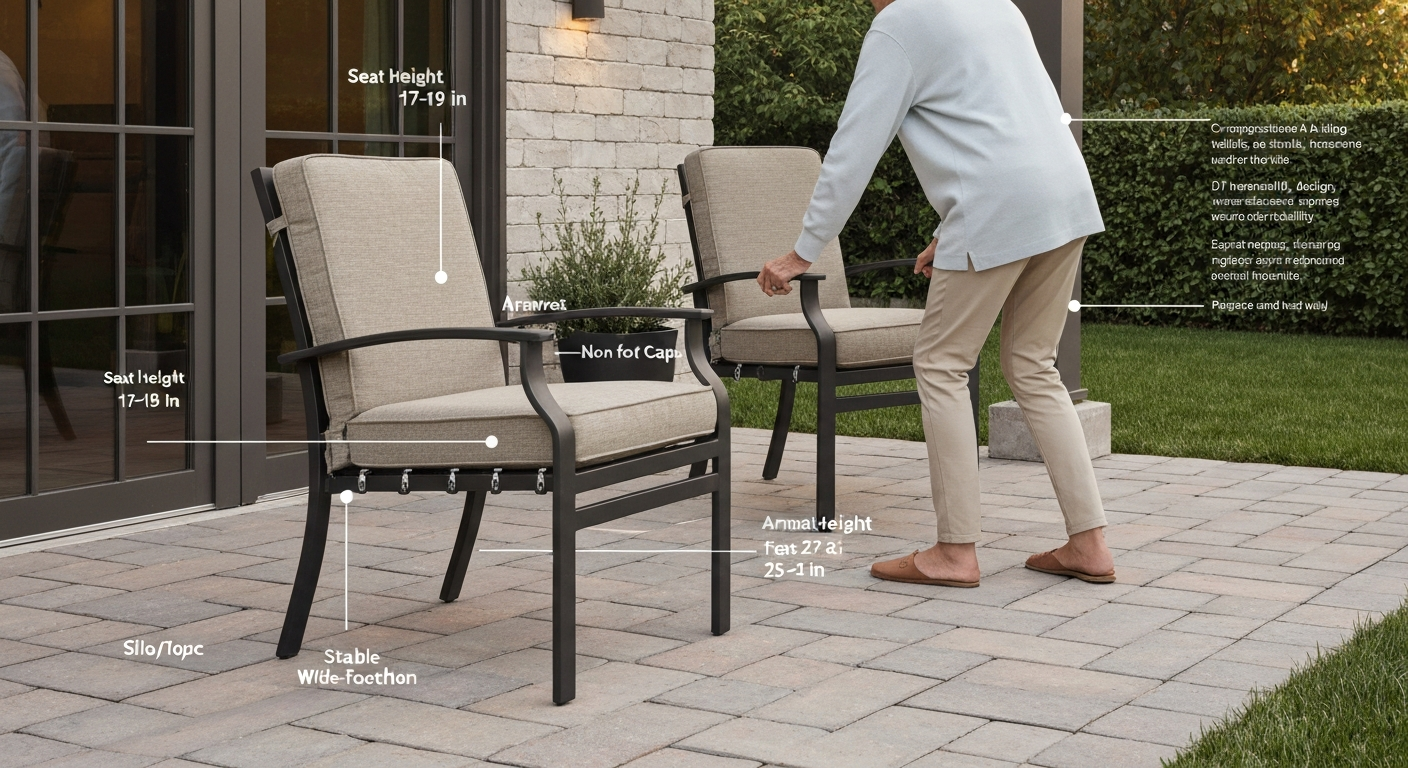
Best Patio Furniture for Seniors: Safety, Comfort & Durability
Best patio furniture for seniors: safe, sturdy seating, climate-wise materials, sizing tips & buying checklist.
How Strict Are Weight Limits on Patio Chairs? Safety Guide
Learn how patio chair weight limits are enforced, what the ratings mean, and how to choose safe seating fast.
Best Patio Furniture for a Large Person: Complete Guide
Choose durable outdoor seating with capacity, size, and weatherproof materials for large frames, plus a quick buying che