
For most uncovered patio seats, reticulated (dry-fast) foam with a density around 1.8 lb/ft³ and an ILD of 33 is the best all-around choice. It drains in minutes, resists mildew, and holds its shape through seasons of rain and humidity. If your cushions live under a pergola or get pulled indoors between uses, a high-resilience (HR) polyurethane foam wrapped in a moisture barrier will outlast reticulated foam and feel more like an indoor cushion. Closed-cell polyethylene foam belongs in marine or flotation applications, not everyday patio seating. Standard polyurethane foam has no business in an outdoor cushion unless it is fully protected from moisture.
Best Foam for Patio Cushions: Guide to Durable Outdoor Cores

Theo Tierney
16 Jul 2026
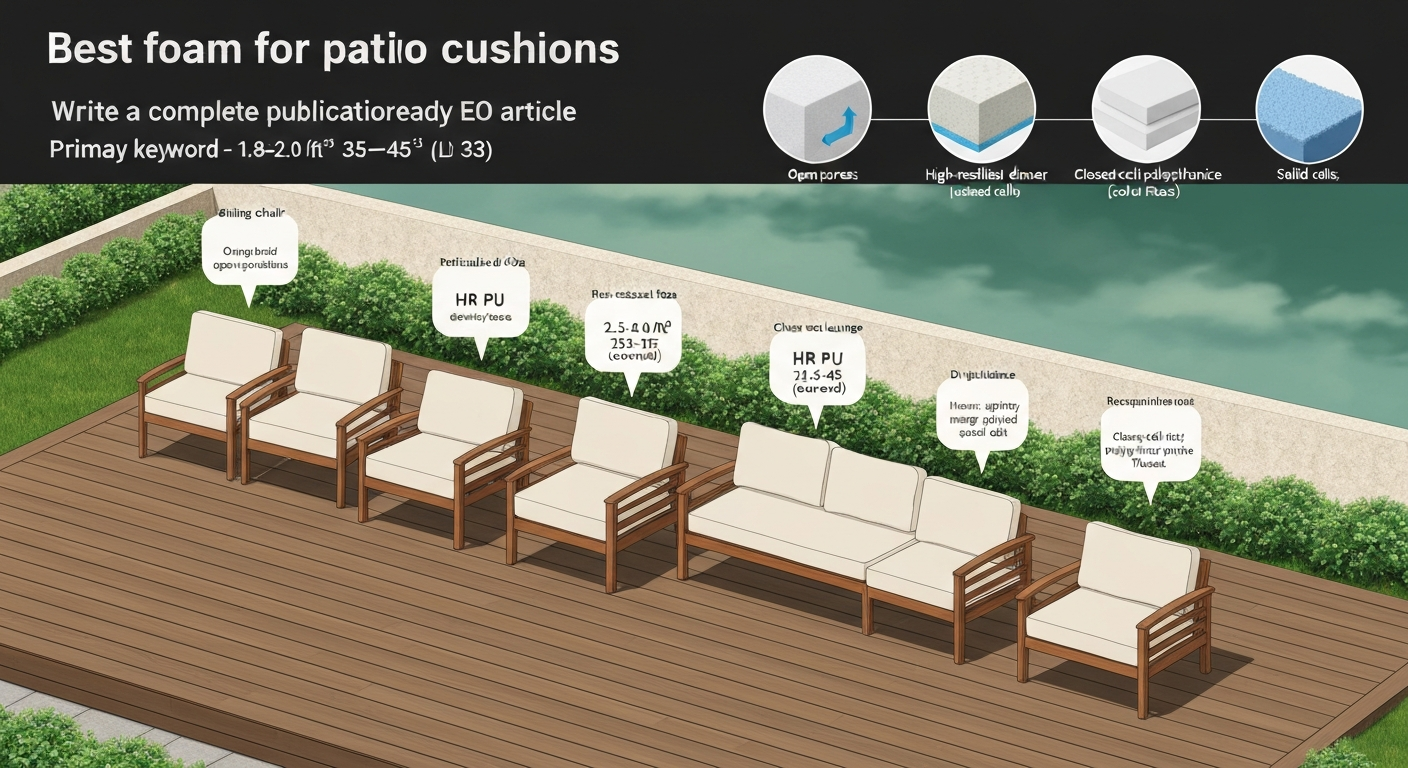
Best foam for patio cushions at a glance
The right foam depends on where the cushion sits, how wet it gets, and how much load it carries. Here is a fast reference before we go deeper.
| Cushion position | Recommended foam type | Density | ILD/IFD target | Typical thickness |
|---|---|---|---|---|
| Seat (dining chair) | Reticulated PU or HR PU (covered) | 1.8–2.5 lb/ft³ | 33–45 ILD | 2–3 in |
| Seat (deep-seating/lounge) | Reticulated PU or HR PU (covered) | 1.8–2.8 lb/ft³ | 33–45 ILD | 4–5 in |
| Back cushion | Reticulated PU or softer HR PU | 1.7–2.0 lb/ft³ | 18–33 ILD | 3–4 in |
| Chaise lounge | Reticulated PU (full exposure) or HR PU (covered) | 1.8–2.0 lb/ft³ | 25–33 ILD | 3–4 in |
| Bench pad | HR PU or reticulated PU | 2.0–2.8 lb/ft³ | 35–45 ILD | 2–4 in |
| Marine / flotation pad | Closed-cell PE foam | varies (~2–4 lb/ft³ common) | Firm/rigid | 1–2 in |
Why foam choice actually matters outdoors
Outdoor cushions live in a punishment environment that indoor upholstery never faces: pooled rainwater, direct UV, humidity cycles that swing from soaking wet to bone dry, salt air on coastal properties, and the weight of people sitting on wet foam repeatedly. Get the foam wrong and you are replacing cushions every two or three seasons. Get it right and a good set can last seven to ten years with basic care.
The foam core does three jobs: it provides comfortable support, it manages water and moisture, and it holds its shape over time under repeated compression. These three requirements are in tension. Foams that drain fastest (reticulated) tend to have lower density and shorter lifespans than premium HR foams. Foams that feel plushest (soft HR or standard PU) absorb moisture and rot if exposed to rain. Understanding that trade-off is the whole game when selecting outdoor cushion foam.
Climate matters too. If you live in a humid Southern climate, near the Gulf Coast, or in the Pacific Northwest, moisture management is your top priority. In the Arizona desert or other arid regions, UV degradation and heat are bigger threats than rain. In snowy climates, seasonal compression from storage and freeze-thaw cycles can crack low-quality foams. The foam type, density, and treatment you choose should reflect your actual conditions, not just a generic product description.
The numbers that actually predict foam performance
Foam is sold with a lot of marketing language. The specs that actually matter are density, ILD (also called IFD), compression set, and drainage performance. These are all measured under ASTM D3574, the U.S. standard for flexible polyurethane foam testing. Any reputable supplier should be able to provide a datasheet with these figures.
Density
Density is measured in pounds per cubic foot (lb/ft³) and reflects how much raw foam material is packed into the structure. Higher density generally means longer lifespan because there is more material to resist breakdown. For outdoor seating, you want at least 1.8 lb/ft³ for reticulated foam and 2.0–2.8 lb/ft³ for HR foam used in protected applications. Foams below 1.5 lb/ft³ are budget-grade and will degrade quickly outdoors.
ILD / IFD (firmness)
ILD stands for Indentation Load Deflection (sometimes called IFD, Indentation Force Deflection). It is measured as the force in pounds required to compress a foam sample by 25 percent of its thickness, per ASTM D3574 Test B1. A higher number means firmer foam. For context: an ILD of 18–25 feels soft, 30–45 feels medium to medium-firm, and above 50 starts to feel quite firm. Most patio seat cushions land best in the 33–45 range. Back cushions and chaise surfaces feel better at 18–33 because they do not bear the same direct compressive load.
Compression set
Compression set (ASTM D3574 Test D) measures how much permanent deformation the foam retains after being compressed for a long period. A low compression set percentage is what you want. Carpenter Co.'s Tranquility foam, for example, reports less than 1 percent compression set even after humid aging, which explains why some premium HR foams hold their shape for years. Cheap foams with high compression set will look like a potato chip within a season or two.
Drainage, perforation, and airflow
Airflow is tested under ASTM D3574 Test G and measured in standard cubic feet per minute (scfm). For outdoor foam, high airflow means water drains and the core dries faster after rain. Reticulated foam achieves extreme airflow because its cell membranes have been physically removed, leaving a skeletal open structure with pores on the order of 200–300 micrometres across. Some suppliers also perforate standard or HR foams with a drill-pattern to aid drainage, but this is a partial solution. A perforated HR foam still holds far more water than a fully reticulated one. For outdoor applications, look for foams with antimicrobial treatment tested to ASTM G21 or ASTM E3364-22 (the standard specifically targeting pink-stain bacteria, Streptomyces). Future Foam's Hyper-Dri reticulated foam, for example, meets both of those standards.
Standard polyurethane foam: cheap for a reason
Standard polyurethane (PU) foam is the foam most people encounter in indoor furniture. It is inexpensive, comfortable, and available everywhere. It is also a poor choice for outdoor cushions unless they are fully protected from moisture at all times.
The problem is that standard PU foam has a closed, intact cell structure that absorbs and holds water. Once wet, it dries slowly and stays damp for hours or days. In warm, humid conditions, that dampness creates a perfect environment for mildew and bacteria to grow inside the core, which degrades the foam and creates odors that are basically impossible to remove. UV exposure compounds this by breaking down the polymer chains at the surface, causing the foam to crumble and yellow.
Where standard PU foam is acceptable outdoors: in fully enclosed cushion covers made from waterproof materials on covered porches that see almost no rain or moisture. Some manufacturers wrap standard PU in a thin polyurethane film (sometimes called a silk film or vapor barrier) to slow water uptake, which extends its usable life. But that is a compromise, not a recommendation. If you are replacing a cushion core and your budget is tight, opt for the least expensive reticulated foam over the most expensive standard PU.
High-resilience (HR) foam: the best choice when you have cover
High-resilience foam is a premium-grade polyurethane with a different polymer structure than standard PU. It springs back faster after compression (hence the name), holds its shape longer, and generally has better durability metrics across the board. Densities of 2.5–3.0 lb/ft³ are common in quality HR formulations, and compression set values under 1 percent are achievable with good product choices.
The catch for outdoor use is the same as standard PU: it absorbs water. HR foam used outdoors needs to be either wrapped in a moisture barrier, used inside a cushion with a fully waterproof shell, or kept on a covered patio where it rarely gets soaked. When those conditions are met, HR foam delivers noticeably better long-term comfort than reticulated foam because it is denser, more supportive, and resists the gradual flattening that lower-density reticulated foam can develop after several years.
HR foam is the right call for screened porches, covered pergolas, and sunrooms where cushions stay dry most of the time. It is also worth considering if you are diligent about pulling cushions indoors when rain is coming. The payoff is a cushion that feels closer to a quality indoor sofa cushion. If your patio furniture is out year-round in a rainy or coastal climate with no cover, skip HR foam and go straight to reticulated.
Reticulated (dry-fast) foam: the outdoor workhorse
Reticulated foam is the standout choice for outdoor cushions that face real weather. The manufacturing process, which uses thermal combustion or chemical etching to remove the cell membranes, leaves an interconnected skeleton of open pores. Water flows straight through it the way it flows through a sponge with no skin. The average pore diameter after reticulation runs in the range of 200–250 micrometres, and the resulting permeability is dramatically higher than any intact-cell foam. Practically speaking, a reticulated foam cushion that gets rained on will feel dry to the touch within 30–60 minutes in mild conditions.
Future Foam's Hyper-Dri product is a representative example of a purpose-built outdoor reticulated foam: density around 1. Future Foam’s Hyper‑Dri specification lists density 1.7 ±0.30 lb/ft³, available IFDs (25% IFD) of 18, 24, 30, 40, 50, and 60 lb (±2), and offers antimicrobial treatment that passes ASTM G21 and ASTM E3364‑22 Future Foam Hyper‑Dri reticulated outdoor foam specification. 7 lb/ft³, available in IFD options of 18, 24, 30, 40, 50, and 60 lb, with antimicrobial treatment that passes both ASTM G21 and ASTM E3364-22. FoamOrder's dry-fast foam comes in at approximately 1.8 lb/ft³ with firmness options around ILD 25, 33, and 45, and they recommend the ILD 33 (medium) as the best starting point for most patio seat cushions. That recommendation aligns with what commercial cushion manufacturers use.
The trade-off with reticulated foam is that lower density translates to a shorter lifespan compared to premium HR foam. It is also less lush-feeling because the open structure provides less material for your body to compress into. In full-sun, all-weather applications it is the right call. For people who prioritize a more upholstered, comfortable feel, reticulated foam on its own can feel a bit sparse, which is why many quality cushion makers wrap it in a thin layer of dacron fiberfill or polyester batting to add surface softness without blocking drainage.
Closed-cell polyethylene foam: not a patio cushion material
Closed-cell cross-linked polyethylene (PE) foam (sold under names like Plastazote, Minicel, or AZOTE) is a nitrogen-expanded foam with a fully sealed cell structure. It does not absorb water at all. It floats. Its densities range roughly from 15 to 115 kg/m³ (around 1 to 7 lb/ft³) depending on grade. These properties make it genuinely excellent for boat flotation cores, marine cockpit pads, pool floats, and any application where waterproof rigidity matters.
For a patio chair cushion, however, it is a mismatch. Closed-cell PE foam is stiff, does not compress comfortably, and cannot conform to body contours the way a flexible PU foam does. Sitting on it for any length of time is uncomfortable. It is also expensive relative to reticulated foam. If you are building outdoor boat cushions, cockpit pads, or floating pool loungers, this is your material. For a dining chair cushion or a deep-seat sofa cushion on your deck, stick with reticulated or HR foam.
Foam comparison: which type fits which situation
| Foam type | Water resistance | Comfort feel | Typical lifespan outdoors | Best application | Avoid when |
|---|---|---|---|---|---|
| Reticulated PU | Excellent (drains fast) | Medium (open structure) | 3–6 years fully exposed | Uncovered patio, poolside, coastal | Maximum comfort is the priority |
| High-resilience (HR) PU | Poor (absorbs water) | Excellent (dense, springy) | 7–10+ years if protected | Covered porch, pergola, screened room | Cushions are left out in rain |
| Standard PU | Poor (absorbs and holds water) | Good initially | 1–3 years outdoors | Fully covered, rarely wet applications | Any real outdoor weather exposure |
| Closed-cell PE | Excellent (waterproof) | Firm/rigid, not plush | Very long (10+ years) | Marine, flotation, boat pads | Everyday comfortable seating |
Choosing foam by use: specs and rules by cushion type
These recommendations draw on specs from commercial cushion makers, foam suppliers, and real-world performance patterns. Use them as your starting point and adjust based on your climate and how protected your furniture is.
Seat cushions (dining chairs)
Dining chair cushions get the most direct compressive load and the least back support from surrounding armrests. A thickness of 2 to 3 inches is the standard range for outdoor dining pads. For foam type, reticulated PU at ILD 33–45 handles full weather exposure well. If the chairs are on a covered patio, HR foam at 2.0–2.5 lb/ft³ with ILD 35–45 will give you a noticeably more comfortable sit and will outlast reticulated foam by several years. A compression set under 5 percent is the benchmark for durability here.
Seat cushions (deep-seating / lounge chairs)
Deep-seating chairs are designed to cradle the body at a reclined angle, so you want more cushion volume. Thickness in the 4 to 5 inch range is typical for commercial deep-seating frames. Density of 1.8–2.8 lb/ft³ and ILD of 33–45 is the working range. For full-exposure furniture, reticulated foam wrapped in a thin Dacron layer adds softness without trapping water. For covered situations, HR foam with a moisture-barrier wrap performs best long-term. The Dacron wrap also helps cushions regain their shape visually after compression.
Back cushions
Back cushions carry significantly less compressive load than seats, so you can drop the ILD. A range of 18–33 ILD at 3 to 4 inches thick is comfortable for most people without feeling overly firm. Reticulated foam in the ILD 24–30 range works well here. If you want a softer, more enveloping back feel on a covered porch, an HR foam at ILD 18–25 is a legitimate upgrade. Avoid going below 1.7 lb/ft³ density on back cushions because they still cycle through tens of thousands of compressions over a few seasons.
Chaise lounges
Chaise cushions are long, frequently poolside, and often damp. This is the single application where reticulated foam is basically non-negotiable unless the chaise is always under cover. Thickness of 3 to 4 inches, density around 1.8 lb/ft³, and ILD in the 25–33 range gives a comfortable lie-flat experience without the foam bottoming out. A chaise cushion also sees water from wet swimsuits, which is a sustained moisture load. Antimicrobial treatment (tested to ASTM E3364-22 for pink-stain resistance) matters here more than anywhere else.
Bench pads
Benches are typically used for dining or as accent seating. They share load across a longer span and often have harder wooden or metal bases. Thickness of 2 to 4 inches with a slightly firmer ILD of 35–45 prevents the bottoming-out feeling you get when a thin, soft pad sits on a hard bench slat. HR foam at 2.0–2.8 lb/ft³ works well on covered benches. Reticulated foam at similar density is the safer call for exposed outdoor benches that collect rain.
Climate-specific guidance
Where you live shapes which foam trade-offs actually matter to you. These are the patterns I see repeated most often in real-world performance.
- Humid South and Gulf Coast (Florida, Louisiana, coastal Georgia): Moisture management is the top priority. Reticulated foam with antimicrobial treatment is the minimum standard. Standard PU or unprotected HR foam will develop mildew odor within one season in these climates. Zippered, removable cushion covers with drainage holes in the base panel help enormously.
- Coastal and salt air (ocean-front properties): Salt accelerates both foam degradation and fabric failure. Reticulated foam handles salt exposure better than intact-cell foams because the water that carries salt also drains out quickly. Rinse cushions with fresh water periodically to clear salt deposits.
- Desert Southwest (Arizona, New Mexico, inland California): UV degradation is the primary threat here rather than moisture. UV breaks down the polymer chains in foam, causing yellowing and surface crumbling. The foam itself is protected inside the cover, but covers degrade fast in direct Arizona sun. Choose solution-dyed acrylic fabrics like Sunbrella rated for UV exposure, and store cushions out of direct sun when not in use to extend foam life.
- Pacific Northwest and rainy climates: Sustained high humidity even without direct rain keeps foam damp for extended periods. Reticulated foam or well-drained HR foam with moisture barriers is essential. Cushion covers with side vents or drainage allow the core to breathe even inside the cover.
- Cold-winter climates (Midwest, Northeast, mountain regions): Foam does not freeze and crack like water pipes, but repeated freeze-thaw cycles on moisture-saturated foam accelerate breakdown. The best practice is to store cushions indoors during winter. If that is not possible, reticulated foam survives outdoor winter storage better than any other type because it holds almost no residual moisture.
Pairing foam with outdoor fabrics and cushion construction
Foam choice and fabric choice interact directly. If you are replacing foam in existing cushions or ordering custom replacements, the cover fabric affects how well the foam performs. Reticulated foam paired with a tightly woven, water-resistant fabric like solution-dyed acrylic (Sunbrella being the most recognized brand) creates a mismatch: the foam drains fast but the tight fabric holds surface water and slows evaporation. For reticulated foam, look for covers with drainage holes at the bottom seam or in the base panel. Mesh-side panels help too. For tested brand and material recommendations, see good housekeeping patio furniture for guidance on outdoor fabrics and cushions.
Olefin fabrics are another common outdoor option. They resist UV and moisture well and are typically less expensive than Sunbrella. They pair acceptably with reticulated foam and work fine for covered-patio HR foam applications. If you are interested in a deeper comparison of fabric options to pair with your foam selection, the topic of best fabric for outdoor patio cushions covers the material tradeoffs in more detail.
Construction details also matter. Tufted cushions trap more water in the dimples. Piped (welted) cushions with non-draining seams can hold standing water along the edge. Cushions with hidden zippers and removable covers allow you to pull the foam core out for inspection and cleaning. For outdoor cushions, a zipper on the back or bottom panel is a genuine functional feature, not just a convenience.
Ready-made vs. custom replacement foam: what to buy
You have two practical routes when replacing or upgrading patio cushion foam: buy ready-made cushions with the foam already inside, or order custom-cut foam and re-stuff existing covers (or pair with new covers).
Ready-made outdoor cushions from major retailers and furniture brands rarely specify their foam type, density, or ILD. The cushion may look great in the store and feel fine at first, but without knowing whether the foam is reticulated or what density it is, you cannot predict how long it will last. For product recommendations and step-by-step advice on replacing patio cushions, see Good Housekeeping's guide to patio furniture replacement cushions. Budget-brand outdoor cushions frequently use low-density standard PU foam regardless of how they are marketed. For shopping options and curated picks, see our guide to the best cushions for patio furniture. If a ready-made cushion does not state foam type and density, assume the core is not outdoor-grade unless you can confirm otherwise.
Custom foam orders from suppliers like FoamOrder or FoamFactory let you specify density, ILD, and foam type, and they will cut to any dimensions you provide. This is the better route for replacement projects, high-quality patio furniture, or any situation where the stock cushion options are not right for your climate. Custom foam costs more upfront but typically delivers better long-term value because you know exactly what you are getting.
Measuring and ordering checklist
- Measure the seat platform: length, width, and depth (front to back), accounting for any tapered or non-rectangular shapes.
- Measure the desired cushion thickness and compare to your frame's raised edge or arm height to avoid overfill.
- Decide on foam type first: reticulated for wet exposure, HR for covered/protected, closed-cell only for marine.
- Specify density (lb/ft³) and ILD: use the tables in this article as your starting point.
- Confirm whether antimicrobial treatment is included if you are in a humid or coastal climate.
- Order foam at least 0.5 inch oversize in each horizontal dimension if the cover has a tight fit, to account for compression after break-in.
- For Dacron wraps, measure the foam dimensions and add 1 inch on each side to account for the batting wrap.
- Check cover construction for drainage holes or mesh panels before ordering foam type: reticulated foam paired with sealed covers loses much of its drainage advantage.
Expected lifespans and cost ranges
Lifespan varies with climate, UV exposure, use frequency, and whether cushions are stored seasonally. These are realistic ranges, not manufacturer promises.
| Foam type | Expected lifespan (outdoor use) | Approximate cost per cushion (DIY foam core) | Notes |
|---|---|---|---|
| Reticulated PU | 3–6 years (full exposure), up to 8 years (partial cover) | $20–$60 depending on size and ILD | Lifespan shortens in sustained UV without cover |
| HR PU (protected) | 7–10+ years | $30–$80 per cut piece | Requires moisture barrier wrap for outdoor use |
| Standard PU | 1–3 years outdoors | $10–$35 | Not recommended for wet outdoor use |
| Closed-cell PE | 10+ years | $25–$70 per cut piece | Appropriate only for marine/flotation use |
Full ready-made replacement outdoor cushions from quality brands typically run $40–$200 per piece depending on size and brand. If you are comparing this against a custom foam replacement, factor in the cost of new covers. In many cases, replacing just the foam core in existing good-quality covers saves money and extends the life of a cushion set you already own.
Maintenance that actually extends foam life
Even the best foam degrades faster with neglect. These steps apply regardless of which foam type you choose.
- Stand cushions on edge after rain to promote drainage and airflow through the core. Leaving them flat face-up pools water on the surface and slows drying.
- Clean covers regularly with mild soap and water to prevent mildew from establishing on the fabric surface before it reaches the foam.
- Inspect zippers and seams annually. A failing zipper that lets water pond inside the cover defeats even the best reticulated foam.
- Store cushions in a ventilated container or indoors during extended periods of non-use. A breathable storage bag is better than a sealed plastic bin, which traps moisture.
- In coastal climates, rinse cushions with fresh water two or three times per season to remove salt accumulation from both the fabric and the foam core.
- Avoid pressure washing foam-filled cushions. High-pressure water can damage foam cell structure and force water deeper than normal exposure would.
- Rotate cushions periodically if you have a set. The seat that gets used most will compress faster than others, creating uneven wear across the set.
Choosing the right foam is the foundation, but the cushion as a whole system, including cover fabric, construction, drainage details, and maintenance habits, determines how long your investment actually lasts. If you are starting from scratch with new patio furniture, the foam choice is one piece of a broader decision that includes frame material, cover fabric, and how your specific outdoor space handles weather. Those surrounding choices deserve the same scrutiny as the foam itself.
FAQ
What is the single best foam type for most uncovered patio seat cushions?
Reticulated (dry‑fast) polyurethane foam is the best general choice for uncovered, frequently wet patio seats because its open, skeletal cell structure drains and breathes quickly. Choose a density around 1.7–2.0 lb/ft³ and a medium‑firm IFD/ILD option (roughly 30–45 IFD/ILD) for good balance of comfort and support.
When should I choose closed‑cell polyethylene or EVA (flotation) foam?
Pick closed‑cell polyethylene or cross‑linked EVA when you need a fully waterproof core, buoyancy (boat pads, flotation or poolside cushions), or extremely low water absorption. These foams do not drain—water won’t soak in—but they’re firmer and less conforming than reticulated or high‑resilience foams.
Is high‑resilience or premium polyurethane foam ever appropriate outdoors?
Yes—use high‑resilience (HR) or antimicrobial treated polyurethane foam for cushions that are in covered or protected outdoor locations (under a pergola, covered porch) where UV/rain exposure is limited. Wrap it in a moisture barrier or use sealed backs and expect the best long‑term comfort and resilience when kept dry.
What foam firmness and density should I pick for seat cushions vs back cushions vs chaise lounge cushions?
Seat cushions: medium‑firm (ILD/IFD ≈30–45, density ≈1.8–2.8 lb/ft³) for durable support. Back cushions: softer (ILD/IFD ≈18–33) and lower density for plush comfort. Chaise/longer loungers: slightly higher density or layered construction (firmer base layer with a softer topper) to avoid mid‑body bottoming and improve longevity.
How important are objective specs (density, ILD/IFD, compression set, airflow)?
Very important—these ASTM‑style metrics predict real performance. Density indicates mass and durability; ILD/IFD gives perceived firmness; compression set predicts permanent sag after long compression; and airflow (or permeability) shows how well the foam will drain and dry. Ask suppliers for these values on datasheets.
What construction and finishing details matter for outdoor cushions?
Crucial details: use zipper closures for easy replacement/cleaning; include boxed or sewn‑in drainage channels or perforations for faster drying (for reticulated foams); use wrap materials (silk film/backer) for protected foam; seal seams or use water‑resistant back panels for added protection; and avoid tufting in exposed cushions unless designed to drain.
Next Articles
Best Fabric for Outdoor Patio Cushions: A Buying Guide
Pick the best outdoor cushion fabric by UV, mildew and water resistance, colorfastness, and care tips for your climate.
Good Housekeeping Patio Furniture Replacement Cushions: Fit, Durability
Guide to buying good housekeeping patio cushion replacements with exact fit, weatherproof durability, comfort, and care
Good Housekeeping Patio Furniture Care Guide by Season
Seasonal care guide for good housekeeping patio furniture: clean by material, stop rust and mildew, prevent fading and c